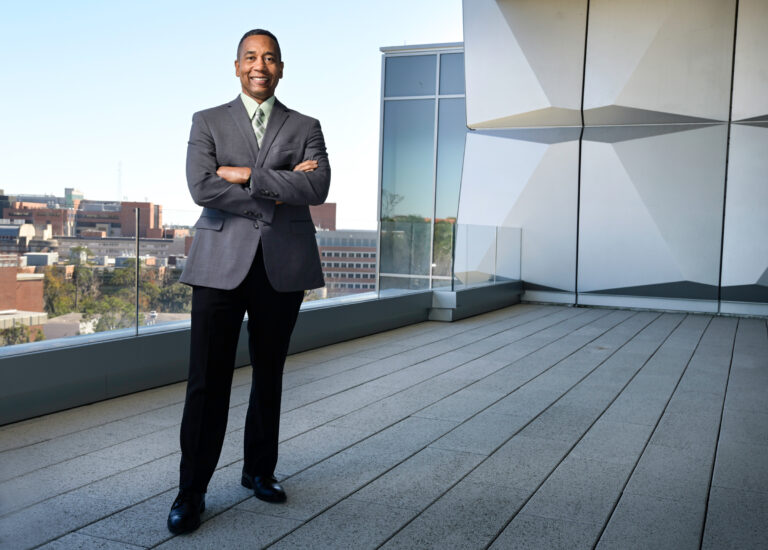
As part of the ESAL America 250 series exploring the intersection of technical systems and local communities, ESAL sat down with Juan E. Gilbert, department chair and human-centered computing researcher at the University of Florida, to discuss the mechanics of voting technology, universal design, and electoral integrity.
This interview has been edited for clarity and length
VG: Your work bridges the human side of voting with computing, accessibility, and the security of voting technology. Was there a specific moment when you realized that election mechanics and democracy would become your primary focus?
Juan E.Gilbert: Coming out of the chaotic 2000 presidential election I was at a conference with my students where we attended a keynote speech about elections. Afterward, my students looked really dejected. They told me that the speaker spent the entire talk detailing everything that was broken about elections and why nothing could ever be fixed. He did not offer any solutions on how to fix the broken system.
That put me in an awkward position. I looked at my students and said, "Of course you want to fix it. Let's go do it." That catalyst is how we ended up in this space.
VG: That is a great story. For context, I grew up in Dubai and studied engineering in Chennai, so I’ve never actually experienced a voting machine firsthand. How bad was the 2000 election?
Juan E. Gilbert: It was bad. Florida was the epicenter for everything—hanging chads and paper ballots that failed to accurately capture a voter's intent. That led us to create the first universally designed voting machine, meaning everyone could vote on the same machine independently, regardless of ability or disability.
We designed it when Congress created the Help America Vote Act in 2002, which required every voting precinct to have at least one accessible machine for people with disability, At the time I told Congress, "You have good intentions, but you've created a separate-but-equal way of voting, and that won't work." People told me no one could vote the same way, but we did it anyway. Fast forward to today, and all voting machines are universally designed voting machines.
VG: When we look at how local communities are affected by these systems, why is it vital for the public and technical professionals to understand the engineering behind how a vote is cast and counted?
Juan E. Gilbert: It’s a major priority right now, primarily due to ongoing attacks from misinformation and disinformation targeting voters. Because there are numerous points where details can get distorted, we must clearly communicate how the mechanics actually work and how votes are securely handled. Commercial vendors need to clearly explain their technology's security to state and county officials, who in turn must accurately relay that information to the public.
Furthermore, as voters go online and encounter the proliferation of LLMs and artificial intelligence, they increasingly turn to these tools to ask who they should vote for. AI creates a potential gap because AI is an opinion without a conscience, meaning people must enter their questions very carefully. In short, the "gap" is the opening for AI to sway voter behavior based on unverified, conscience-free outputs when voters rely on it for election choices. To build trust, I would love to see more public demonstrations where voting machines are brought out into the public square for real-time testing. Although vendors often worry that public exposure might create vulnerabilities, my recommendation is to let people interact with and test the technology beforehand.
VG: Let’s talk about design and accessibility. When designing a ballot, what human factors do you rely on to ensure people with disabilities can vote independently and privately? And how do remote methods fit in?
Juan E. Gilbert: For in-person voting, it starts by acknowledging that you want people with disabilities to have the same accessible usability experience as anyone else. You have to understand how they interact daily with paper, other methods, and technology, and then model that in a voting environment. We designed for a broad demographic spanning all kinds of variations: if you can’t see, can’t hear, can’t read, or don’t have arms, you can vote on the same technology.
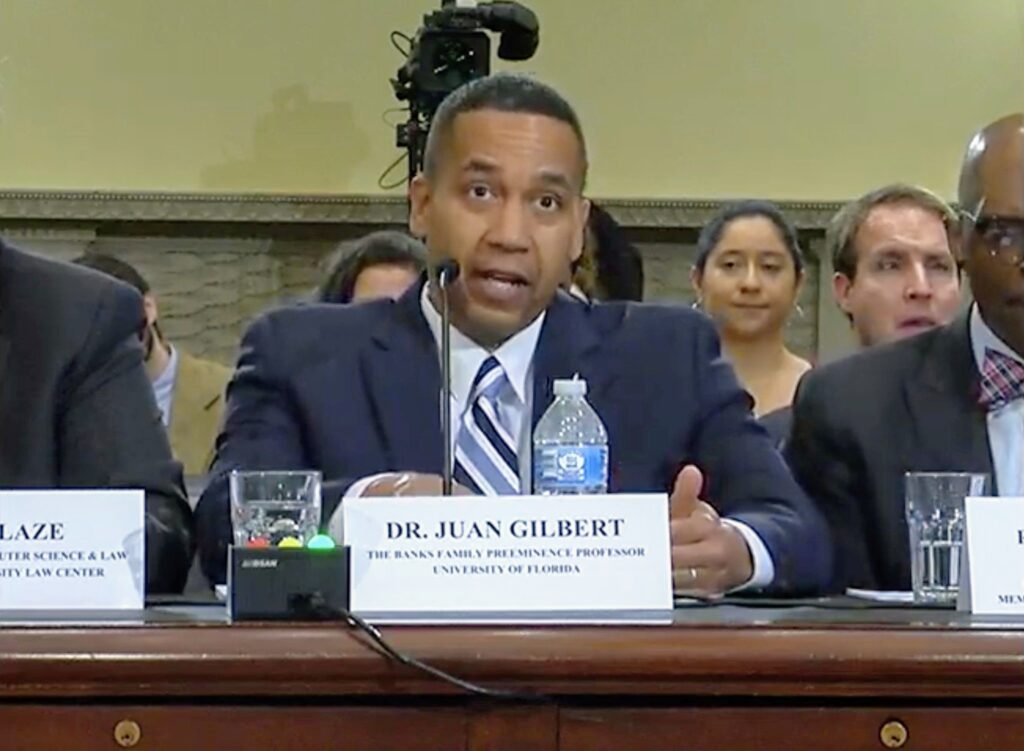
Interestingly, we discovered a security benefit: if only blind people vote on a machine, it's easier to deceive them. But if everyone is voting on it and you can't tell who is a blind or sighted voter, it is much more challenging to deceive them.
For remote or absentee voting, we have a new technology called televoting where you don't have to mail ballots anymore. You use a video conference app to meet with a remote poll worker who verifies your identity in real time. Once verified, you cast your vote through the app, and the ballot is printed on-site in the precinct.
VG: Before a system goes live, what usability or testing is performed? And do you think certification should be standardized?
Juan E. Gilbert: As a researcher, I'm not a voting machine vendor, so my lab doesn't get certified. Vendors go through state and federal certification testing for usability, security, and accessibility. However, prior to a specific election, testing guidelines vary from state to state and county to county.
It's hard to say whether it should be standardized. There is power in not being standardized and having a diverse way of doing things, but there is also an argument that we need uniformity. I'm hesitant to go either way because I can see both sides.
VG: How do modern systems handle alternative methods like ranked-choice voting, which introduces complex computational challenges and cognitive loads?
Juan E. Gilbert: Ranked-choice voting is uniquely complicated. If you're blind, you have to hold all the candidates and your assigned numbers in your head, and even for a sighted person with a large number of candidates, keeping track of the rankings requires additional cognitive load. To help solve this and make it accessible, jurisdictions like California use assistive tools, such as headphones and screen-reader cursors that allow blind voters to listen to and navigate the rankings. But ranked voting still remains inherently harder to process
VG: Open-source validation is standard in most technical fields, but voting technology remains heavily proprietary. How do you work with that tension?
Juan E. Gilbert: There is only one voting machine manufacturer doing open-source work; everyone else does not due to proprietary secrets and fears of vulnerability. I don't believe open source makes you vulnerable. In our lab, we actually invite hackers to try and hack our systems and give them the source code. They won't touch our stuff because they don't know how to hack it—having the source code doesn't help them compromise it. Traditional views persist, and voting right now is just behind and hasn't caught up.
VG: When discrepancies arise between unofficial election night tallies and final certified counts, anxiety rises. What causes these gaps, and how do modern systems evolve to eliminate them?
Juan E. Gilbert: The resolution is hand-counting paper ballots, which is hard for big jurisdictions, or running them through scanning machines again during a recount. Statistical methods like risk-limiting audits also exist through our colleagues in statistics. But our focus is producing an accurate, voter-verifiable ballot and reliable tally methods from the start.
VG: For scientists and engineers reading this who want to support accuracy and integrity in their local elections, what is the most impactful way to apply their technical skills?
Juan E. Gilbert: First, understand how elections work—volunteer to be a poll worker and watch how it actually works. Then, use your expertise to say, "I know how it works and here's something I think could be improved," and apply your skills to improve it.
VG: As someone balancing academic and advocacy demands, what keeps you hopeful as the nation enters its 250th anniversary?
Juan E. Gilbert: I'm hopeful about innovation and this next generation. I'm hopeful that they will not only innovate, but actually translate those innovations into the real world—so that everyone can vote independent of their ability or disability in a safe, secure way, and every voter-verified ballot is counted as cast.