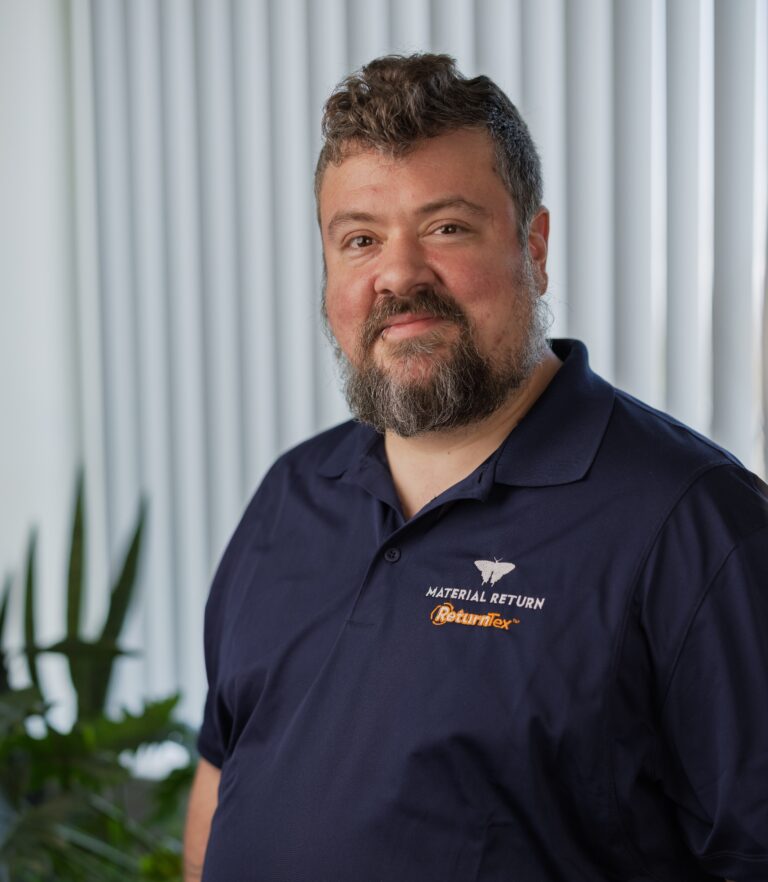
In the foothills of North Carolina, The Industrial Commons is building a new model for regional manufacturing, one that centers worker ownership, circular economy principles, and deep local roots. From recycling textile waste to launching bookkeeping and housing cooperatives, this nonprofit is proving that innovation and equity can go hand in hand.
We spoke with Bobby Carswell, production, research and development senior director at Material Return, a worker-owned circular textile mill incubated by the Industrial Commons, about how STEM expertise is being applied to transform industry and community alike.
This interview has been edited for content and clarity.
Bobby Carswell: I’m the production, research and development senior director at Material Return, a worker cooperative focused on circular textile manufacturing.
The Industrial Commons is a nonprofit that roots wealth locally by launching worker-owned businesses. They incubate cooperatives like Material Return that tackle real industry problems, especially in legacy sectors like textiles.
What does “circular textile manufacturing” mean?
Carswell: It means taking end-of-life textiles (shirts, socks, anything made of fabric), and utilizing them as a feedstock for the regular production of the next cycle of products.
Traditional manufacturing is “take, make, waste.” Ours is a loop that always stays in circularity, where your next product line is all made of the textiles from the previous production cycle. [In fact, Material Return] is one of the only U.S. facilities to take it to full circularity inside the same factory.
Carswell:I went to Western Piedmont, our local community college, to get electrical engineering and computer engineering degrees. Then, in 2019, Sara Chester, co-founder of the Industrial Commons, was doing a story on me through the Work in Burke program, [which teaches marketable skills and develops career pathways]. She asked “Hey, do you want to do something crazy and start a textile circularity manufacturing company?” I said, “Sure, why not?”
I already had a linear manufacturing background so I knew the old school furniture industry. I saw thousands of pounds per month go into the landfill, and this seemed like the perfect way to give back.
Carswell: Burke County, NC has deep manufacturing roots. But there's been an exodus of manufacturing, which was held by massive companies that employed 1500 workers each. When that happened, it devastated our community; everybody I went to school with, their parents lost jobs. Unemployment skyrocketed.
Today, this is our company, and we don't want to sell. We need the industry to stay here because of long-term jobs and generational security. Seeing our community get devastated by companies uprooting because it's cheaper is one of the things we're trying to combat at the Industrial Commons.
Carswell: We started with a box truck and a favor. It took seven years to figure out what we needed, get it installed, and get it up to medium-scale pilot production. Now we collect a million pounds of textile waste a year, but I'm only able to turn probably 25% of that into a new textile because the infrastructure is not there. There really hasn't been a lot of government policy through incentives or brand policy, where the brand actually puts up money to close the loop on their product. Whereas in Europe, the EU is pushing for laws to adopt circular systems through extended producer responsibility.
That same law has now moved to California, and it's going to spread across the U.S. Right now, we're the only infrastructure. There are a couple other businesses that are doing collection, aggregation, and sorting, but we're the only ones set up to do the entire process, and we're in no way able to handle the entire national supply chain of textile waste. Luckily, the Industrial Commons was awarded multiple grants, including one through the National Science Foundation.
Carswell: It's not just about rooting wealth locally, and it's not just cooperative ownership models, but it's also the incubation of businesses based on solving problems in our industry and region.
When Material Return launched, we didn’t have a bookkeeper, so we brought one into the ecosystem and became their first client.
There’s also housing. The housing market in western North Carolina has probably quadrupled in pricing; there's no affordable housing for people in middle- to low-income levels. The living wage here is $11/hr but our houses are just as expensive as Asheville and Charlotte. So that's another issue that Industrial Commons is working on: where if we see a problem, we start a cooperative.
Carswell: Our mission comprises three pillars: people, planet, and profit. People are our main focus, followed by the planet, meaning being sustainable and environmentally friendly. Profit is what keeps us commercially viable. We took 30 people to Mondragon in Spain, to study their cooperative ecosystem and see how they are staying relevant. They have been at it for 75 years and have over 70,000 workers in different industrial cooperatives. We’re only seven years in, and our goal is to figure out how to get each cooperative business to scale quicker because we realize that the need is out there, and we don't even have a real marketing budget; it’s word of mouth. The key is to have an amazing product, deliver it on time, and at a good price point.
Carswell: I kind of lucked into it, but I also worked hard. I realized early on that I wanted to go into engineering because of my experience in manufacturing. Any experience in manufacturing confers many transferable skills and knowledge in other industries. I also taught at the college, where I learned more teaching than I did actually attending college. In short, I’d say to just be open to the experience. Everything we do takes effort, but if you enjoy engineering or STEM, it will be rewarded because everything counts as experience, and that goes really well on a resume. Eventually, somebody may see that passion and skill and come to you with an opportunity.
It doesn’t have to be a straightforward path. We didn’t have a rulebook for how to set up Material Return, because no one was doing anything like it. You just figure it out, iterate, and be able to pivot quickly.
Another piece of advice: Consider all the people in your ecosystem. I think about the cotton farmer, the processors that get the fiber to me, and the weaver. There's so many steps. You want to keep everybody at the table, including partners, customers, and suppliers. This industry, for example, is too small to burn bridges without word going around.
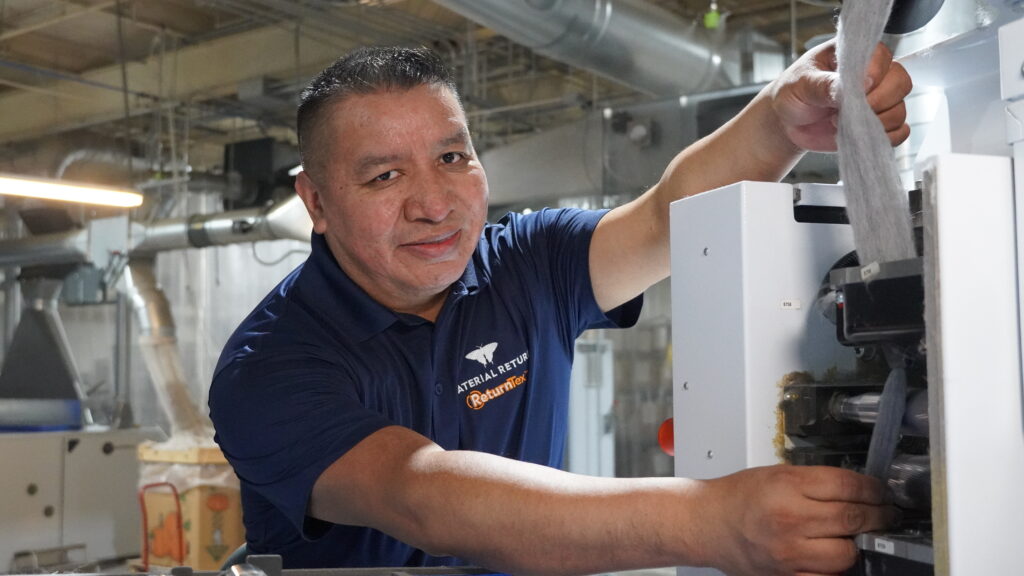
Carswell: Innovation and sustainability are two areas where we’ve been lacking in the textile industry, but everything we do at Material Return is highly technical and modernized. Nobody wants to work at an old, dusty factory with oily machines everywhere. When you come in here, everything's automated and computerized, so you need to be a really good technician and engineer to repair and keep stuff running. It's fun.
I like engineering. I mean, it's frustrating, of course: you get a busted knuckle here and there whenever you're trying to fix a machine, but one of the most rewarding things is to see something highly technical functioning on a daily basis that you and your team put together.
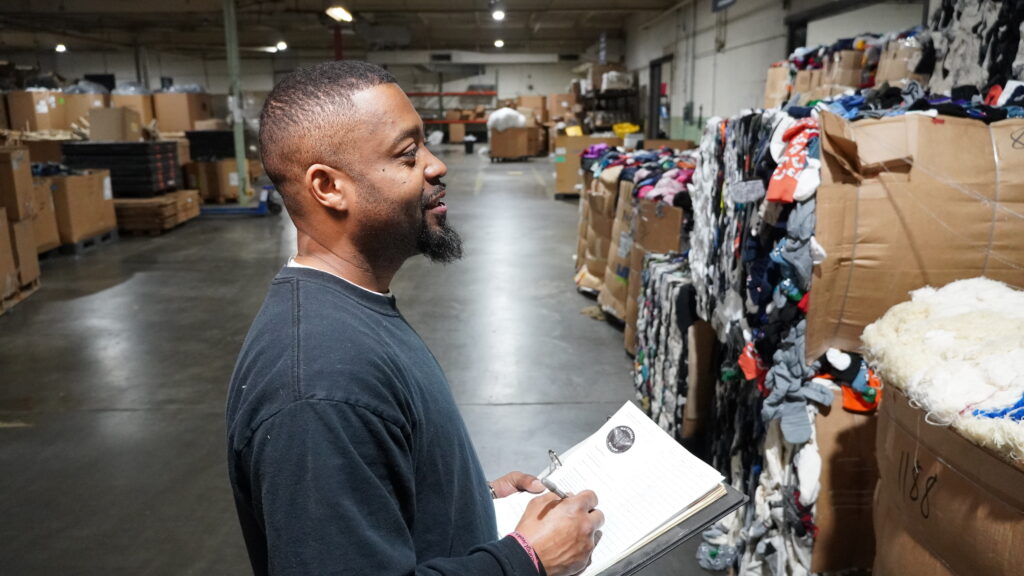
Carswell: So we've been doing this about six or seven years now, and we are just now slightly vertically integrated. Being able to control all the points of circular textile production, aggregation, and sorting is the only way to do this correctly, to do it all in-house. With the growing industry, we need to be able to handle more and scale; probably our biggest task is to hire more people to become worker-members.
We host open houses at the Industrial Commons, and it's always a packed house. The Industrial Commons is also becoming more involved in things like zoning boards, parks and recreation, and other local government and community involvement. [Looking to Spain as an inspiration] I want to know what the Industrial Commons could look like in 75 years.
“We need the industry to stay here because of long-term jobs and generational security. Seeing our community get devastated by companies uprooting because it's cheaper is one of the things we're trying to combat at the Industrial Commons.”
Bobby Carswell
Are you involved with an organization or effort that you think might be of interest to the ESAL community? Or have heard about an organization or initiative that you’d like to learn more about? Let us know here, and we may feature it in a future post.