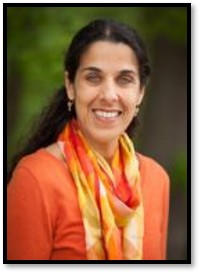
Anjali Deshpande, Ph.D., is the board president at the Iowa Public Health Association (IPHA), where she oversees IPHA’s initiatives and provides strategic oversight of public health efforts at the state and local levels. Deshpande completed her doctorate in epidemiology from Emory University and was a research assistant professor at Washington University in St. Louis before joining the University of Iowa as a clinical associate professor and director of the college’s Master of Public Health in 2016. Deshpande reflects on IPHA’s accomplishments as a whole, and more specifically, its work with regard to immunizations and health equity.
This interview has been edited for clarity and length.
ES: Could you tell us more about yourself and what led you to join the Iowa Public Health Association (IPHA)?
Deshpande: When I was in college, I was drawn toward understanding disease and its etiology. This interest led me to study microbiology and immunology during my undergraduate education. In fact, I thought I would be a bench scientist investigating the biology behind disease for the remainder of my career. However, at some point along my journey, I realized I wanted to pursue a career that involved more interaction with people.
I later realized that I could combine my passion for microbiology with my newfound interest in public health, specifically epidemiology. As a master’s student, I had the opportunity to work at the local state health department on the disease detectives team. I really enjoyed our workflow of going out into the local communities or other counties in the state to investigate outbreaks.
Following my master’s, I completed my Ph.D. in epidemiology and eventually joined academia. My academic career has primarily focused on cancer prevention and control. In 2016, I had the opportunity to become the director of the University of Iowa’s Master of Public Health program. Upon moving to Iowa, I joined the state public health association, which was primarily motivated by my wanting to learn more about the state of Iowa. IPHA could inform me about what is important to the state when it comes to public health and offered me the opportunity to meet people and engage with public health practitioners.
ES: How has your work as a professor helped you navigate IPHA’s initiatives and community outreach?
Deshpande: First, as a professor, you have to stay up to date on the critical issues within the field. For example, how are methodologies related to the science behind public health changing? This engagement has been super helpful with regard to staying on top of current events as well. Second, building skills in grant writing and collaboration with individuals and organizations has been very useful. These skills are the more traditional components of academic work.
As a member of IPHA, I also gain critical insights into the infrastructure of public health— oftentimes information that is not necessarily taught through textbooks. For example, I have witnessed firsthand the recent changes in public health funding and technological advancements through AI. Bringing these real-world examples to the classroom has been immensely helpful in not only teaching my students but also informing communities about science. IPHA has been an excellent way for me to bridge the gap between science and academics, leading to impactful action.
ES: Could you elaborate on IPHA’s community outreach efforts?
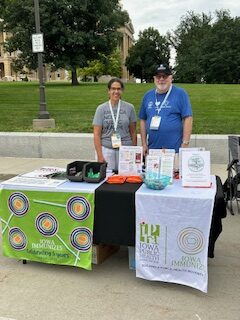
Deshpande: One of the key areas we do work in is immunizations. In Iowa, we have a coalition called Iowa Immunizes, which brings together stakeholders who are involved and interested in immunization. These stakeholders consist of health professionals, health departments, parents, community members, and even schools. Through Iowa Immunizes, IPHA does extensive education of the public, which includes attending meetings, organizing community events, and publishing information on our website. For example, Iowa recently hosted the National Senior Games here in Des Moines. We set up a table at this event to educate older individuals on the significance of immunizations.
Another area we focus on is health equity, which is at the core of the work that public health does. We are striving to build communities where everyone has the opportunity to achieve their best health. For this work, we do not necessarily engage directly with the community. Instead, we show the value of it by partnering with different community groups. Our efforts to support local organizations amplify their work, especially when it comes to topics, such as social drivers of health or non-medical factors that relate to health.
ES: How did IPHA come to spread awareness about epilepsy, which is oftentimes a topic overlooked?
Deshpande: Our epilepsy work actually originated from the personal experience of one of our staff members. It was an opportunity for us to amplify the work of one of our partnering organizations that had extensive experience with epilepsy awareness. This experience reflects a key aspect of IPHA’s culture— if members indicate a topic is of interest or importance to them, or they are observing their community needs, we frequently initiate work in that specific area.
ES: What has been IPHA’s biggest accomplishment in its 100-year history?
Deshpande: We recently had a 100-year celebration walking through IPHA’s history, which revealed many accomplishments we are proud of. Most significantly, however, IPHA has worked incredibly hard to build a reputation as the trusted voice for public health in Iowa. Through governor turnover and other obstacles, IPHA has persevered and maintained focus on promoting the importance of public health in Iowa. This resilience has cemented IPHA’s reputation as a reliable source of information.
ES: In contrast, have there been any recent obstacles or challenges that IPHA has had to overcome?
Deshpande: The biggest challenge we have recently faced is regarding funding. Not only to IPHA directly, but funding to the Centers for Disease Control and Prevention and other non-governmental organizations has been drastically reduced. This reduction in funding ultimately trickles down to the state level and makes promoting public health difficult.
Additionally, it is not yet clear what the federal “Make America Healthy Again” campaign will involve at the state level and this provides uncertainty to the field of public health as a whole. This ultimately makes it difficult for us to plan our future initiatives and allocate resources effectively. We are working hard to strategically design our efforts such that we can maintain our social and political capital and provide support to Iowa’s communities.
ES: In light of the recent funding challenges, what do you see in store for IPHA in the immediate future?
Deshpande: We have a few different areas that we are focused on. Our number one priority is to ensure that, as the state public health association for Iowa, we continue dedicating our work to our members, particularly state and local public health practitioners, as well as partner agencies in the state. It is crucial that we remain strong and are in tune with their needs. For example, are there ways we can support local organizations differently? Can we take on alternate responsibilities to alleviate stress that local organizations are facing? These efforts can extend beyond the local areas to the state level as well.
Our second priority is advocacy. It is not enough to simply do the work, but we have to be able to talk about it. We will need to disseminate information to decision-makers and demonstrate why it is crucial to invest in public health. Our advocacy will also extend to networking— bringing on new partners, building new relationships, and maintaining the ones we already have. Public health is a dynamic field, and if IPHA stays nimble, I firmly believe we can continue to enact positive change.
Do you have a story to tell about your own local engagement or of someone you know? Please submit your idea here , and we will help you develop and share your story for our series.