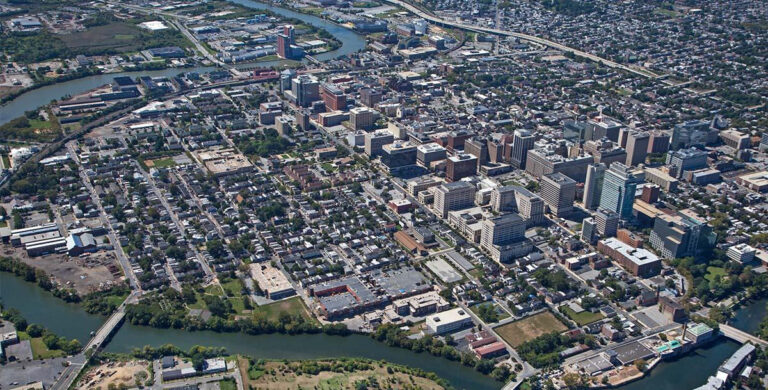
When my family and I moved to Wilmington, Delaware, in 2025 for my new research position, we found a city defined by contrasts. You can spend your weekends strolling the Brandywine Creek State Park, exploring industrial history at the Hagley Museum, and dining on the Riverfront, while also encountering significant corners of abandonment. As Wilmington’s industrial core—from riverfront shipbuilding and railcar manufacturing to textiles and automotive assembly—unraveled over the 20th century, the city’s population dropped from a peak of roughly 112,000 to near 70,000. Yet Delaware’s tax incentives eventually turned the city into a financial hub and legal home to over 60% of Fortune 500 companies, bringing glassy office towers and thousands of daily commuters. That banking boom did not fully mend the social fabric for many working-class residents. Passing the shuttered houses, I wondered about the scale and causes of Wilmington’s housing vacancy and what solutions are being pursued to fix it.
As a data scientist, my first instinct was to look for public data to find answers. A lot of credit goes to Wilmington’s municipal government for maintaining and publishing two exceptional datasets on local vacancy.
The portal revealed that roughly 6% (1,593) of the 28,565 total properties in Wilmington are currently flagged as vacant, with 89% having been vacant for over a year. The issue is overwhelmingly residential—92% of vacant properties are homes—the rest are commercial, industrial, or land.
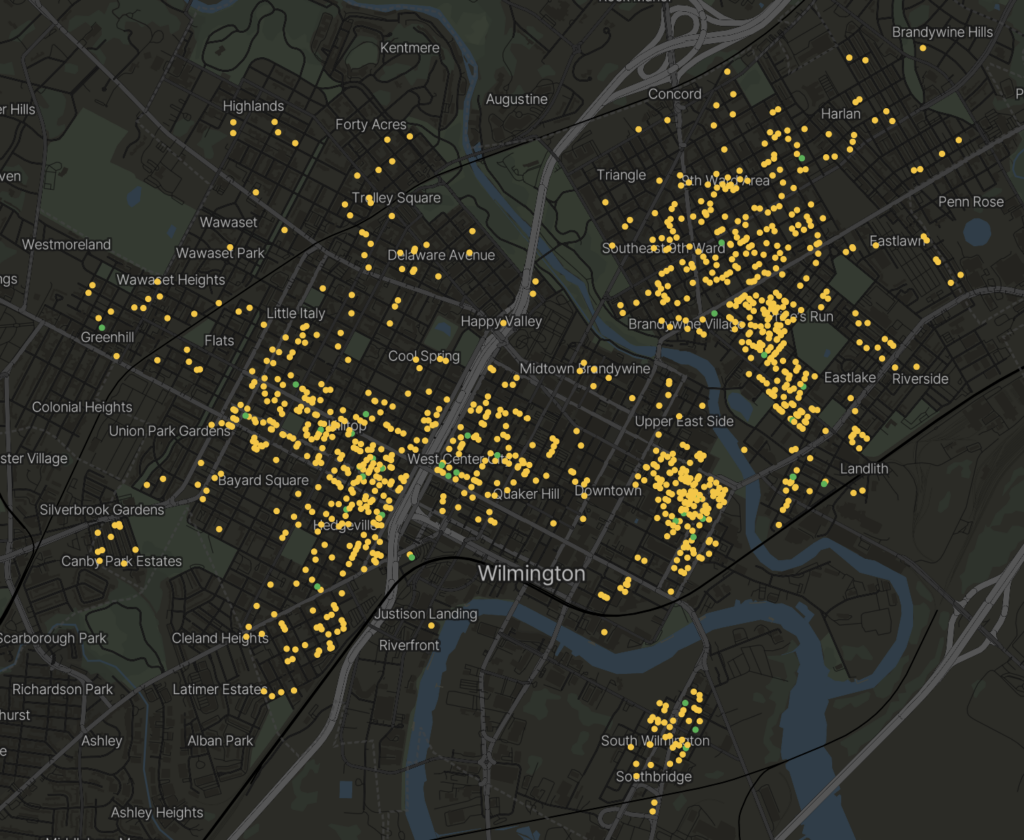
A view of Wilmington, Delaware from the Building Blocks portal, with some neighborhoods labeled and the locations of vacant structures shown with yellow dots.
Overlaying spatial data with demographic and historical records reveals a distinct concentration of housing vacancies in Wilmington’s most economically distressed neighborhoods. Vacancies cluster in areas where home values fall well below the regional average—typically under $175,000—reinforcing a destructive feedback loop between abandonment and depressed property values.
These neighborhoods exhibit compounding social vulnerabilities characterized by:
Beyond economic strain, ownership patterns point to deep market instability: only 6% of vacant properties have been held by the same owner for 10 or more years, indicating a volatile cycle of rapid turnover. Furthermore, the physical age of the vacant structures presents a major barrier to recovery. While 55% of all housing in Wilmington was built before 1940 (and 21% before 1900), a striking 80% of vacant properties were built before 1940, and 40% before 1900. This suggests that a large fraction of vacant homes are reaching the end of their functional lives, where remediation costs far outweigh any potential return on investment.
The street addresses from the vacancy registry revealed that abandonment heavily clusters along historic urban corridors where now-vanished 19th- and 20th-century industries once anchored communities. Some examples:
The 1,061 registered properties are controlled by 845 distinct entities and individuals. While 89% of owners hold one vacant property, 11% hold multiple properties and collectively control nearly 30% of the city's total vacancy. The geographic distribution of owners mainly highlights local stakes:
The largest portfolios belong to public, quasi-governmental, or nonprofit entities attempting to absorb, hold, and remediate local housing decay however, several private corporate entities also hold significant clusters of vacant properties.
| Entity | Entity Type | Properties Held | Role & Operational Focus |
| Wilmington Neighborhood Conservancy Land Bank | Quasi-governmental / Nonprofit | 41 | Created in 2016 by state legislation and the City to serve as a central repository, acquiring tax-delinquent and abandoned properties to clear tangled titles and return parcels to productive, affordable use. |
| Delaware Affordable Housing | Mission-driven housing group | 24 | Holds properties under local or state funding streams slated for subsidized rehabilitation and long-term, low-income residential use. |
| Todmorden East Foundation LLC | Nonprofit foundation | 15 | Established on the philanthropic legacy of industrialist William Poole Bancroft to preserve and develop affordable rental housing in neighborhoods like The Flats. |
| PG & Sons Properties LLC | Private corporate entity | 13 | Regional real estate investment firm focusing on entry-level residential acquisitions, short-hold renovations, and multi-family units. |
| AKR / AKRR Acquisitions LLC | Private corporate entity | 10 | Corporate private equity vehicle holding a portfolio of distressed single-family and rowhouse assets in high-vacancy corridors. |
| Wilmington Housing Authority | Public housing agency | 8 | The city's official housing authority, holding parcels tied to public redevelopment initiatives, federal housing programs, or site assemblies. |
| City of Wilmington | Municipal government | 8 | Directly owned municipal parcels, typically acquired via tax sales, sheriff auctions, or municipal liens awaiting public disposition. |
An analysis of large portfolio holders reveals a correlation between an owner's core mission and their geographic clustering. Mission‑driven owners — nonprofits, foundations, and public entities — show the strongest clustering, often concentrating their portfolios on specific blocks or neighborhoods. Todmorden East Foundation, for example, holds 14 of its 15 properties on the East Side; the Land Bank clusters 20 of its 41 holdings in South Wilmington; and Delaware Affordable Housing centers its 24‑property portfolio in West Center City.
Conversely, Private Developers & Investment LLCs show minimal clustering, indicating opportunistic acquisitions. For example, the 13 properties owned by PG & Sons Properties LLC are scattered across the East Side, South Wilmington, Browntown, Northwest Boulevard, and Price's Run, with no street having more than 2 properties.
Roughly 19.3% of the inventory (307 properties) is controlled by “micro-portfolios”—LLCs holding one to three properties. Investors frequently utilize these small entities to isolate legal liability, shield personal assets, obscure the true scale of a broader property empire, and leverage depreciation or security write-offs to offset taxes on other business ventures. Furthermore, distressed homes acquired cheaply at tax auctions can be held vacant as long-term speculative bets on future neighborhood appreciation.
Tackling a vacancy footprint of more than 1,500 properties requires a coordinated response from legislators, municipal agencies, and neighborhood developers deploying creative legal and financial strategies. Local authorities are shifting from sluggish bureaucracy to aggressive enforcement. For example, Wilmington imposes $500 penalties in the first year of vacancy, scaling to $5,000+ after a decade. Wilmington City Council also passed legislation changing vacant property penalties from criminal offenses to civil citations, allowing code enforcement to penalize negligent owners more efficiently and the city to seize properties if violations go unanswered by owners. If owners accumulate massive unpaid property taxes, sewer bills, or vacant registration fees, the city can force tax foreclosure to expedite the property to Sheriff sales.
To keep foreclosed properties out of speculative hands, local organizations are driving targeted revitalization. For example, the Wilmington Neighborhood Conservancy Land Bank offers low-cost acquisitions for buyers who commit to strict renovation timelines or community gardens. Programs like Jumpstart Wilmington and multi-agency initiatives (such as Vacant Spaces to Livable Places, which cut county vacancies by 53% since 2017,) train local developers, provide construction loans, and transfer severely damaged properties for a low or no cost to trusted non-profits to build affordable housing.
But even as initiatives like the Delaware Catalyst Fund expect to produce about 60 new affordable units in Wilmington, tension persists over how to allocate limited housing funds. This recently came to a head when the current mayor, who favors developer subsidies, vetoed an Affordable Housing Trust Fund aimed at rental assistance, eviction defense, and homeless services — a veto that the City Council narrowly failed to override.
More than anything, my analysis of the Building Blocks Portal and the Vacancy Registration List helped me appreciate the deep structural complexity of abandonment in Wilmington, Delaware. The collapse of nineteenth- and twentieth-century industries (such as leather tanneries, rail, shipyards, and traditional retail), despite the rise of banking and finance, left wounds that are still healing 50 to 100 years later. That many of the vacancies concentrate in economically depressed pockets (seemingly locked in a destructive cycle), once anchored by these lost industries, illustrates how enduring and profound the effects of major economic shifts can be. And it should cause us to pause when approaching the economic shifts that we currently face.
Beyond economic distress, the physical reality of the housing stock provides another cautionary tale. With the vast majority of vacant homes built as worker housing before 1940, many are reaching the end of their functional lifespans. This exposes a broader blind spot in real estate economics: homes are often viewed as eternal assets, lacking any built-in insurance or long-term reserve plans for the eventual demolition and complete rebuild required at the end of a structure's life.
Legal and ownership challenges further complicate recovery. Roughly 30% of vacancies are tied to "microportfolios" and private LLCs that may use abandoned properties as tax shelters, legal shields, or speculative long-term land plays. Meanwhile, local individual owners frequently struggle to keep pace with mounting bills and deferred maintenance. Balancing these pressures requires navigating intense friction over how to modernize neighborhoods without displacing longtime residents, all while tackling overlapping crises of homelessness, rental assistance, and a severe regional housing shortage.
Despite it all, I think Wilmington's municipal agencies and community groups deserve tremendous credit for aggressively deploying data-driven enforcement and redevelopment pipelines. Wilmington is not an anomaly, but a case study in the natural life cycle of human-built systems. Cities function like living ecologies: populations shift, economies pivot, technologies disrupt, and neighborhoods cycle through growth and decay. Much like deadwood in a forest, an abandoned 1890s rowhome represents the structural residue of a bygone economic era. Equipped with the right tools—strategic land banking, localized developer programs, structural end-of-life planning, and intentional economic transitions—urban decay can be recycled into the foundation of a more resilient community.