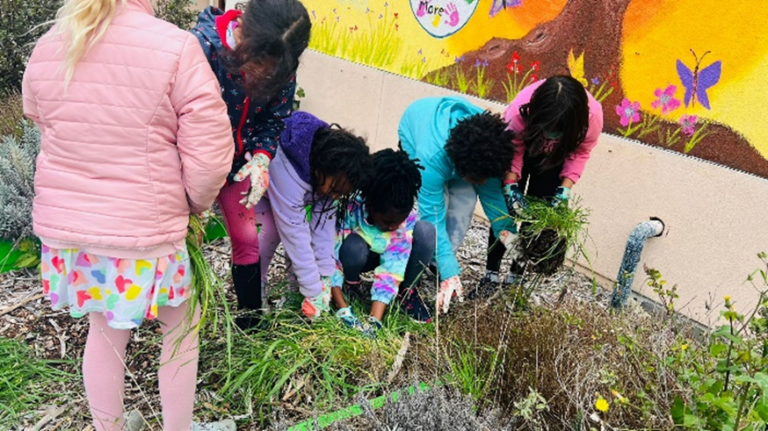
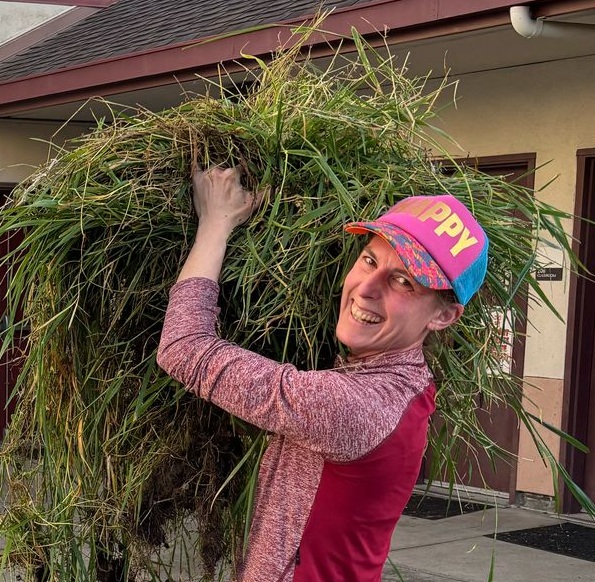
Bettina Christle is a senior chemist at Charm Industrial who has brought her passion for sustainability to her local community. She has helped lead initiatives such as the Garden Club, where students learn about plants and gain hands-on experience with garden maintenance, and the Green Challenge, which encourages students to adopt more sustainable habits in their day-to-day lives. In this interview, Christle shares her journey and what she has learned from getting involved in her community.
This interview has been edited for clarity and length.
ESAL: Tell me about your background and how it helped shape your interest in environmental work and sustainability?
Bettina Christle: Growing up, I spent a lot of time outdoors. My family went camping every year, hiked on the weekends, and us kids played in the fields and the forest near my hometown almost every day. My parents taught us not to be wasteful and made us aware of our responsibility to protect the animals and plants around us. Having grown up in that kind of environment, I feel connected to nature and want to do my part to preserve it.
Professionally, I’m a chemist. I went to school in Germany and studied chemistry, did my PhD, and worked at several different companies. In the beginning I was looking for job opportunities that allowed me to use my skills and grow as a scientist. Since I’ve come to the U.S., I’ve been able to work for companies dedicated to contributing to a greener and more sustainable future. At Halio, Inc., I was involved in improving production and analytical processes used to manufacture eco-friendly electrochromic windows, a technology that allowed customers to manage heat and light penetration and offered energy savings and carbon-emission reductions in buildings. After that, I worked for Novoloop, a company that turns nonrecyclable plastic waste into performance materials and thus creates circularity. Now, I’m working for Charm Industrial, where we convert biomass into carbon-rich bio oil and pump it underground to permanently remove CO2 from the atmosphere.
ESAL: What inspired you to start projects like the Garden Club and Green Challenge, and what have you learned from them?
Bettina Christle: I feel that our lifestyle, at least the lifestyle I experienced (in Germany and even more in the Bay area), leads to a lot of environmental issues. Life is fast, and everything has to be convenient. We buy things we don’t need; we replace instead of repair broken items; we want convenience, and don’t think about the consequences such as the waste created from disposable cups. I wanted to do something about it but felt that just changing things within our own family would not have much of an impact and in a conversation with a friend of my daughter, who was also the PTA president at the time, I learned that I could volunteer and offer green activities to students and, that way, reach the school community.
My first project was the Green Challenge. I adapted a citywide sustainability program into weekly activities for students, such as using reusable water bottles and grocery bags. Teachers helped track participation, and the kids brought those habits home, sparking conversations with their families. It wasn’t always smooth, but it reached a large portion of the school and showed how small changes can impact wider awareness.
Taking friends of my kids on hikes in nearby regional parks and watching them climb trees and rocks and explore nature helped me notice that many kids had few opportunities to connect with nature and little exposure to working with soil or plants. A request from a teacher for help to build raised beds in the school’s courtyard gave me the idea to start a school garden. At first, I started with planned activities, but I quickly saw they learned best through following their own curiosity - digging in the dirt, asking questions, and exploring on their own. After initially accepting 30 kids with no or only one other parent volunteer, I quickly learned that it’s better to start with a small group of students and then expand once you have older kids who can help lead.
ESAL: Can you tell us more about the Green Challenge?
Bettina Christle: As mentioned, the idea was initiated through a conversation with the PTA president and inspired by a Green Challenge that BrightAction had created for the city of Fremont (now called My Climate Ready Fremont), which involved a bunch of easy activities that the community could join in on, and adapted them for our school community.
Each week, students had simple goals, such as using reusable water bottles or bringing grocery bags, and then reported back to their teachers. It was tricky at first since teachers already had a lot on their plates, but about a third of the school participated, which I felt was a strong start. Many activities also encouraged kids to talk with their parents, so it sparked family conversations around new habits like line-drying clothes or starting small home gardens.
ESAL: What other issues in your community would you like to work on solving?
Bettina Christle: One idea has been improving sustainability in schools, such as reducing cafeteria waste. But a lot of that is already being addressed; our school has a compost system, uses compostable trays, and even hosts field trips to the recycling center. So I see my role more as supporting and building on those efforts where I can.
This year, I’d like to start planning monthly activities outside of school, such as neighborhood trash cleanups where students can start conversations with community members and even raise funds for the school’s green team. I’d also love to organize other projects, like collecting unused fruit from neighborhood trees and turning it into juice to sell, just things like that, which can raise awareness within the broader community.
ESAL: How have these projects shaped your connection with the community?
Bettina Christle: I feel like they have made me a lot more connected to the community and school. I’ve gotten to know many more kids, teachers, staff, and also learn about their values and what they care about, even those not directly involved with the projects. Overall, I think engaging with your community can be a really fulfilling experience.
ESAL: What advice would you give to someone who wants to address similar problems in their community?
Bettina Christle: Be visible with your work. I’ve learned that newsletters or emails often don’t reach people, but being present where the community already gathers makes a big difference. For example, setting up a small stand in front of the school during pickup or drop-off is a great way to show what you’re doing and invite people to get involved.
It’s also powerful to have kids take the lead. When children share their projects or ask for support, people listen more closely because they see the effort is genuine. I’ve even seen teachers train students to approach local stores for donations, which worked really well. Giving kids that responsibility not only makes the projects more effective but also teaches them valuable skills.
Finally, I think persistence is really important. When you follow up with people and keep reaching out, you can get more people involved, and projects can grow over time.
Do you have a story to tell about your own local engagement or of someone you know? Please submit your idea here , and we will help you develop and share your story for our series.