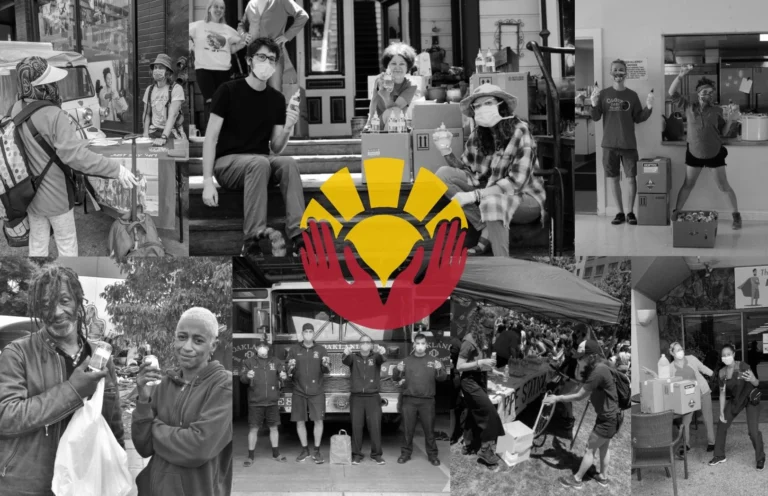
Common Humanity Collective (CHC) is a decentralized mutual aid organization based in the Bay Area initially formed with the aim of providing free masks to local community members for the ongoing COVID-19 pandemic and Northern California wildfires. They have since expanded their focus to distributing DIY air purifiers, among other mutual aid efforts and collaborations with other local organizations.
Statement from CHC: “Because some mutual aid work is unnecessarily politicized and even wrongly criminalized, Common Humanity Collective organizers collaboratively answered these questions without using their names.”
This interview has been edited for clarity and length.
How did your organization come to be? Can you tell us a little about the work you do?
In early 2020, due to the COVID-19 pandemic, organizers in the San Francisco Bay Area began developing do-it-yourself solutions to product shortages such as masks and hand sanitizer, and distributing those supplies for free. That work became the basis for Common Humanity Collective.
Over the past six years, CHC has continued to focus on clean air solutions, including respirator masks like N95s and DIY air purifiers constructed from simple, widely available materials. We operate as a decentralized mutual aid collective, with no formal institutional support. We source and distribute tens of thousands of masks for free every year, and we host public events where we build our purifiers to share that knowledge with other groups and empower them to keep passing along these skills.
Could you explain why mutual aid organizations like yours are important for local efforts, especially to folks who are unfamiliar to your type of organization?
Mutual aid is an old idea often attributed to Russian philosopher Peter Kropotkin, and it basically means freely and unconditionally meeting others’ needs regardless of scarcity and authority. We believe basic health and safety supplies should be free for anyone who wants to use them and that anyone should be able to clean their indoor air or access masks they need to stay safe.
In many major U.S. cities, residents can get masks delivered only because volunteer groups like ours exist. Our work exists on a spectrum of other harm-reduction efforts such as condom distribution to address the HIV/AIDS crisis and free needle exchange sites that support people who use intravenous drugs.
What is the motivation for a decentralized organization? What impacts does this kind of organization have on the work you do?
Decentralized organizing enables any member of our group to spearhead projects they find meaningful or useful, and this model supports individuals acting within their own capacity, doing anything from designing new prototypes (like air purifiers or low-power radios for natural disaster scenarios) fundraising, sourcing supplies, and more. Some organizers deliver supplies to a dozen individuals every week. A lot of our members are disabled or otherwise marginalized, and we know everyone has a role to play and that they’re able to decide what that role should be.
The only unfortunate aspect of autonomous organizing is that as a grassroots, volunteer-run group, we don’t qualify for most major grants and other types of traditional funding available to official nonprofits. This means that we spend a lot of time fundraising when we could be helping people. However, our members can be nimble and autonomous, which is ultimately more valuable to us than becoming a 501(c)(3), an organization status that comes with a lot of administrative responsibility. So we rely heavily on individual donations from the communities we support.
Can you tell us a little more about your process of making the purifiers, both the design and the construction process?
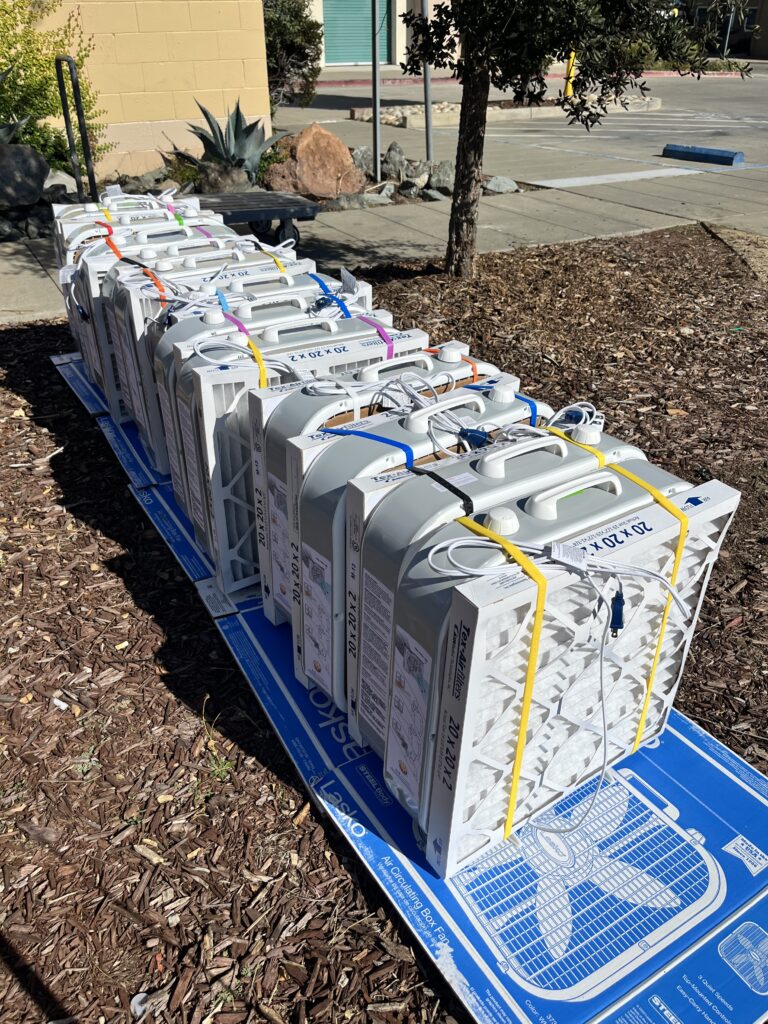
For design, we optimize primarily for low cost, approachable and fast construction, ease of filter replacement, efficiency, and low noise, which is perhaps the most important performance parameter. Secondarily, we optimize for portability and compactness, wide availability of parts, aesthetic acceptability, and “throw” of the exhaust stream, meaning it stirs up air across the room.
Our main model consists of a box fan, a cardboard shroud for the exhaust, foam weatherstripping, a furnace filter, and rubber bands to hold the filter on. The shroud organizes the circular fan exhaust and prevents bypass backflow in the corners. The rubber bands make filter swaps straightforward, something we want to encourage so that people actually use the purifiers for more than just a few months. A local stamping shop cuts the shrouds for us from the discarded cardboard boxes that the fans came in. It saves a lot of time and doesn’t cost much. (video tutorial)
Some builds we do craftsperson-style, in which participants build complete units from start to finish. Other builds we do assembly line-style, with stations for each step. The type of building event depends on the number of units we want to construct and the kind of experience participants want to have.
On your website, you mention collaborating with other local organizations or events. Can you highlight one or more such collaborations, and what you were able to accomplish together?
Most of our work is collaborative, so it’s tough to decide which orgs to highlight! We’ve co-hosted purifier building workshops at places like Radically Fit, an Oakland gym for all bodies, and Moments Co-op, a volunteer-run bookstore and cultural space. Sometimes we also show up to share information or demonstrate solidarity with like-minded groups. We table at events like mutual aid fairs, Pride events, and disability community gatherings. Last year, CHC organizers joined members of 350 Bay Area to distribute 1,000 commercial air purifiers to residents in Martinez, who live near heavily polluting refineries that have caught fire several times.
What impacts have you noticed within your community since you began your work? Any specifically compelling anecdotes or statistics?
There are many more groups like ours than there used to be! We’re part of an ever-expanding network of groups across California and across the country that source and distribute clean air supplies. We’re in touch with groups like ours that distribute masks and other PPE, and we often share resources. This has been especially vital during California wildfire season, when California groups often rely on one another for extra supplies. During the first week of the 2025 Los Angeles fires, CHC organizers drove trucks of masks to Los Angeles, where mutual aid organizers distributed hundreds of thousands of masks within the first week of the fires. We often witness ordinary people doing what officials and institutions will not, and we’re continually struck by the people power that actually keeps individuals safe during disasters.
In terms of specific moments, at one purifier build we co-hosted with Moments Co-op in downtown Oakland, community members passing by on their way to work or running errands stopped to chat because they were curious about our work. A few wanted purifiers to take home, so we distributed what we were building directly to people who stopped to inquire. We don’t always learn how our work impacts folks, and we don’t always meet them personally! But that afternoon, those on-the-spot distributions, to people living and working in the immediate area, felt like the entire reason Common Humanity Collective exists.
How have your activities and your approaches to them changed over the years that you have been active? What do you hope to accomplish in the coming months?
We’ve always tried to stay responsive to community needs. California’s fire agency predicts wildfire season may be bad this summer, and as we’ve seen across the U.S., Canada, and alarming swaths of Europe recently, enormous fires are causing immense harm. Clean air advocacy addresses a lot of disastrous situations we all encounter too frequently, whether it's during wildfire season or during surges of airborne illness. CHC formed to address COVID-19, and it continues because many of our organizers learned more about clean air in recent years and now value the safety of clean air in many contexts.
In terms of specific projects, in the coming months, we’ll be co-hosting a DIY air purifier building event with students at a university who run a mask-distribution mutual aid group much like ours. The students are interested in expanding their work to purifier distribution, so we’re excited to share our design and support them building a bunch of their own purifiers for dorms and classrooms.
How can readers get started with mutual aid in their own communities? Where can people who want to get involved with you connect with you?
We love that mutual aid is such an old concept because within that history are innumerable examples of creative people-powered projects. In a way, it’s too bad that mutual aid becomes a buzzword following disasters and violence because the idea of unconditionally supporting others has tremendous everyday impact. When other organizers ask us at CHC what they should prioritize, we always tell them: you know your community best. What does your community want and need?
Readers can check out our website for descriptions about mutual aid as well, and of course, we welcome anyone to contact us through our website if they’d like to organize with us, or support us in our 2026 fundraiser.
Are you involved with an organization or effort that you think might be of interest to the ESAL community? Or have heard about an organization or initiative that you’d like to learn more about? Let us know here, and we may feature it in a future post.