Many STEM professionals express the desire to make a difference in their communities. Getting started, however, is oftentimes a challenge. The driver? Not motivation, but rather uncertainty.
If this sounds like you, some of your questions may include: What does civic engagement actually look like? Where should I begin? How much time does it take? And how can my technical expertise be useful, without becoming the sole focus?
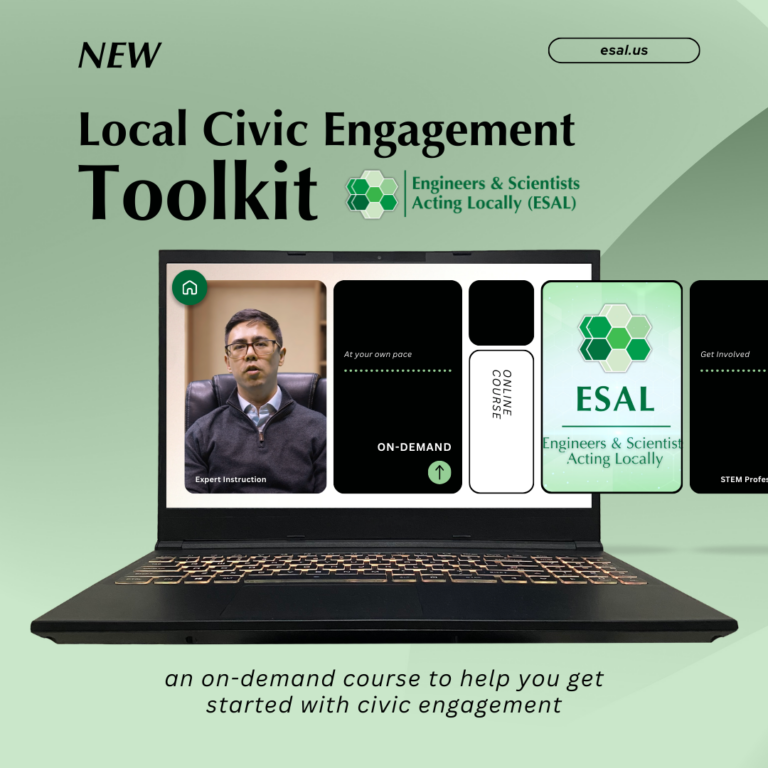
These questions have shaped much of the work at Engineers & Scientists Acting Locally (ESAL), from workshops and storytelling initiatives to peer learning spaces. Most recently, they also informed the development of ESAL’s new on-demand video course: The Local Civic Engagement Toolkit. This resource is designed to help STEM professionals move from curiosity to confident participation.
ESAL’s Program Manager, Al Licata, and Workshops Director, Chris Jackson co-developed the course, with Jackson serving as the narrator in the course videos. In conversation, they reflected on what helps people move from interest to action and why local civic engagement becomes more approachable when it is broken into smaller, more practical steps.
A values-first mindset is central to the new course. Rather than focusing exclusively on policy mechanics or advocacy tactics, the course guides learners through the same reflective process that has shaped ESAL’s mission and storytelling work: understanding personal motivations, learning how local systems function, and identifying meaningful entry points for engagement.
By combining video interviews, practical exercises and curated resources, the course draws on the rich library of content ESAL has already developed, while bringing new insights and materials to support sustained learning.
According to Licata, one of the biggest barriers to engagement is knowing where to start. “People often ask, ‘What should I do?’” they said. “But a more helpful place to start is understanding what matters to you and why.”
Taking this moment of reflection can shape not only how people get involved but also impact how long they stay involved. It’s no secret that civic work can be complex and slow-moving. Without a clear connection to personal values, participation can easily start to feel disconnected or unsustainable.
For STEM professionals, this can represent an important shift. On one hand, technical training often emphasizes efficiency and problem-solving. On the flip side, community engagement usually starts with listening: understanding local context, relationships, and priorities before proposing solutions. By providing an intentional learning progression, the course helps participants move from reflection to action.
Storytelling is an important aspect of ESAL’s mission, and Jackson believes it plays an essential role in helping people imagine themselves in these roles as civic participants.
“Hearing how someone else identified an issue, built relationships, and took action makes the process feel more real,” he said.
ESAL has long documented these journeys through its stories from the field series, which showcase a wide range of interviews on civic experiences, ranging from environmental advocacy to community science education and infrastructure planning.
These examples help demonstrate that civic engagement is not a single pathway but rather a set of possibilities shaped by local context.
The course also reinforces the importance of showing up through real-world examples. Learners hear directly from scientists and engineers who describe how simply attending meetings, volunteering their expertise, or building relationships became the foundation for deeper civic involvement. These stories mirror the experiences ESAL has documented for years through its Stories from the Field series.
Jackson said that another common misconception is that civic engagement requires specialized expertise from the start.
“Many STEM professionals are waiting for the perfect invitation,” he said. “They imagine someone will approach them with a technical problem only they can solve.”
At the local level, that scenario is uncommon. Instead, influence tends to grow through familiarity and trust. That process often begins with simply being present by talking with neighbors and learning how decisions are made.
“Showing up is not just preparation,” Jackson said. “In many ways, showing up is the work.”
Licata agrees. Civic engagement is inherently relational. Even individual actions involve interacting with others, including neighbors, nonprofit leaders, educators or local officials.
“You cannot do civic work in isolation,” they said. “It is about deciding together what the future of a community should look like.”
Both Licata and Jackson emphasized that local civic spaces can feel more approachable than national advocacy. Issues are closer to daily life, decision-makers may be more accessible, and outcomes can be visible.
“You are often working with people who live in your community,” Jackson said. “That creates opportunities for direct relationships and meaningful influence that many people do not realize they have.”
Licata noted that local engagement can also produce tangible results on shorter timelines. Actions centered around community planning decisions, environmental protections, or transportation improvements can have direct and immediate effects on a community’s daily routines and quality of life.
ESAL highlights these kinds of efforts through its coverage of local STEM initiatives, where scientists and engineers who have taken the steps to get involved collaborate with community residents, educators, and policymakers to address specific place-based challenges.
Local civic spaces can also offer diverse entry points. Some people contribute technical expertise, while others focus on communication, organizing, research or coalition building. The variety of pathways can make it easier for newcomers to find a role that fits their interests and capacity.
Licata encourages people to reframe civic participation as a shared endeavor.
“One of the most powerful questions is not ‘What should I do?’ but ‘What should we do?’” they said.
For STEM professionals who are accustomed to independent problem-solving, this collective approach can require some adjustment. But in the end, it often leads to stronger relationships and more sustainable impact.
To help participants continue this learning beyond the videos, the course connects learners to ESAL Community, a national community of STEM civic practitioners. In this space, learners can ask questions, exchange ideas, and find peer support as they navigate local challenges.
“It’s about finding your place in a broader effort,” Licata said. “Being open to learning and recognizing that change happens through collaboration.”
Licata and Jackson both emphasized that civic engagement does not require a grand strategy at the outset.
Instead, they suggest thinking in terms of manageable steps:
“You do not need to have everything figured out before you begin,” Jackson said. “Once people take that first step, new opportunities tend to open.”
For STEM professionals hesitant about how to contribute locally, there’s good news. Civic engagement is not just for policy specialists or seasoned advocates. It grows over time through curiosity, relationships, and participation. In many cases, starting small is exactly how lasting change begins.
If you are looking for a structured way to explore these ideas further, ESAL’s new course, The Local Civic Engagement Toolkit, offers a guided introduction. Designed as an on-demand learning experience, the course brings together interviews, exercises, and community insights to help participants translate interest into action.
Author’s note: Al Licata is the program manager for ESAL. Chris Jackson serves as the treasurer for the ESAL board of directors, as well as workshops director.