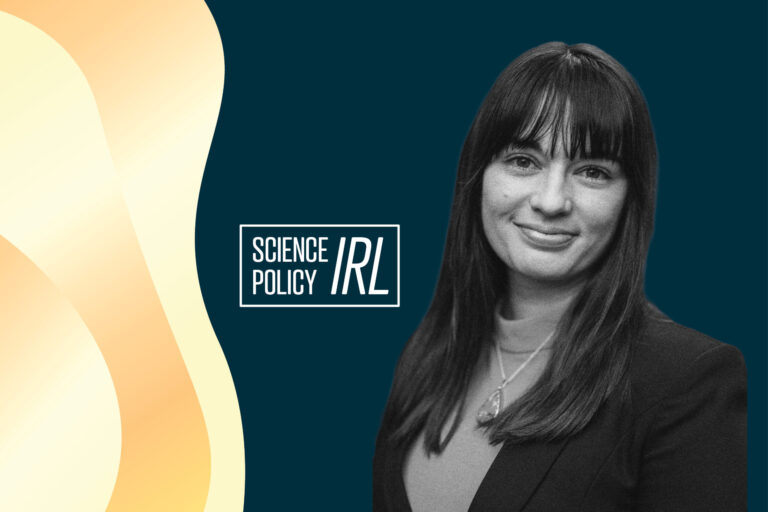
Lisa Margonelli, the editor in chief at Issues in Science & Technology hosted ESAL's executive director, Taylor Spicer on the Science Policy IRL podcast.
The conversation weaves together motivations for civic engagement where you live, tips for starting your civic engagement journey, ESAL's role in supporting people with STEM backgrounds acting locally, and ways Spicer's background and own civic journey informs how she leads ESAL.
Margonelli: Welcome to The Ongoing Transformation, a podcast from Issues in Science and Technology. Issues is a quarterly journal published by the National Academy of Sciences and Arizona State University.
I’m Lisa Margonelli, editor-in-chief of Issues. On our series, Science Policy IRL, we talk to people in science policy about what they do and how they got there. We’ve shared stories of how people have found their way into science policy careers at places like the White House, Congress and federal agencies. In this episode, we’re exploring a different way into science policy: getting involved with your local government.
I’m joined today by Taylor Spicer, the executive director of Engineers and Scientists Acting Locally or ESAL, to learn how her organization helps scientists and engineers get involved in local policy. Taylor talks to us about how she went from international development to leading an organization dedicated to local civic engagement, why it’s important for people with STEM backgrounds to get involved with policy in their own backyards, and how ESAL’s Network can help you get started.
Taylor, welcome. I’m so excited to talk with you today. Let’s start with our usual first question. How do you define science policy?
Spicer: Thanks for this question, Lisa. As someone who just learned of this idea about two years ago, I would love to first answer how I, as someone not of the field, would have thought about it before entering into it. So I am a former sustainability practitioner and I would’ve honestly interpreted this term to be some other name for maybe political science or possibly a way of thinking of shaping policy for safe and supportive uses of science by government. But now that I’ve been welcomed into the field, I do understand more of the commonly used definitions about science for policy and policy for science. So that, to me, means using scientific knowledge to inform policy making and rulemaking, and then setting policies that help shape boundaries and opportunities for the work of science to be done.
But through our work, I see more of the ways that people choosing to participate civically actually shapes how they show up in the world, and also show up for science policy purposes at all levels of decision making, whether that’s federal, state, local, or all of the above. So there’s the individual part of it, of how we are shaped and then therefore our work is shaped, but then also at more of a political cultural level, so how our culture and expectations of policy making, of our government, of governance, how it shapes our civic health. And when I say civic health, I mean an overarching effort to understand how our communities are organized to define and address public needs and opportunities. So there’s a duality here.
Margonelli: Yes, and I think in order to get into this duality, which is super interesting, we need to understand what is Engineers and Scientists Acting Locally?
Spicer: So Engineers and Scientists Acting Locally is serving the STEM community as a source for state and local engagement information, instruction and some inspiration, sharing stories, helping find the motivation for all of us to take the step or take multiple steps out into our communities to use what we have, what we know, make our connections and bring it all together to help shape the quality of life in our communities.
Margonelli: So if I were an engineer and let’s say I lived in Maine, where I live, and I wanted to join my local town or county water management district on the board, I could do that and be a STEM person, a STEM resource in my community, but I could also join Engineers and Scientists Acting Locally.
Spicer: There will be different impacts, of course, so we would hope you might do both because there are advantages to being a part of a network of folks of similar backgrounds that have similar motivations, but it will not be the same as you choosing to directly engage with your community where you live. Because from us, you’ll hear certain types of supports and resources and ideas, but from your community, you’ll hear very locally informed opinions, perceptions, solutions that you then become a part of. So it’s just a different choice. But again, we’d hope you make both so that you could have more support while you serve in that civic role, whatever it may be.
Our mission is to increase local civic engagement by people with backgrounds in STEM, intentionally inclusive of many ways that one could show up because to us, it is important not to prescribe for everyone what you should do because it will not work for everyone. It will not work for every community. An example, some communities have an opportunity to participate in citizen assemblies. It’s a structure designed for input from community members. If I told you, Lisa, to go do that in Maine and you try, you may realize that it doesn’t exist. So there’s not always the same type of opportunities for civic engagement. So we give as much universal training or information as we think we can, and then mostly work with individuals or groups to tailor that based upon where you’re living or what you’re trying to achieve by doing the work.
Margonelli: And so this experience with acting locally and with working with a network group of 2000 STEM professionals across the country who are also networked to each other and also working locally, that has given you this insight into science policy that’s multi-levels. As you put it, it’s both this individual action in your community and then it’s also how you change that community.
Spicer: Yes, I think it is inclusive of the more commonly used definitions of science policy. I think if someone came to us, wanted to do that at the state or other local scale, that would be a good fit for our organization. We have people who’ve done it. We have resources to, again, help you take the steps and soon, we will have more of an organizing structure to help you find more of the people you need to do the work effectively. So yes, our goal is to not limit people’s thoughts and choices about how to show up in their communities because there are a multitude of ways. You do not have to solely try to influence policies or science or integrate science into policymaking. You can still shape decisions by ways that you work with local institutions, nonprofits, citizens groups, how you deliver your comments in town halls, public hearings, how you author op-eds in your local newspaper, how you serve in advisory ways through appointments to local boards and commissions.
And so really by being more inclusive there, hopefully others see it as an opening of more opportunities to pursue because we can’t all do one thing and expect to be able to influence a lot of different outcomes, but all of us doing things in different ways together and united for an overall purpose of using science for the public good can have really amazing outcomes when we are networked, working together, sharing information and helping us not all start from zero. So I think when people pivot to science policy, sometimes there’s a lot of information gaps, a cultural gap of how things get done and relational gaps. And so if we, through the network, are able to share more of that foundational information, help us all not start from zero, it becomes additive and it grows from there.
Margonelli: It’s such an interesting community, and I love the way you’ve described it because it’s much more relational than some of the standard science policy discourse, which is really about influencing policy itself, and this is really about having these relationships within society at different levels. Now you live in Georgia. Can you tell me something that you did with ESAL early on in your relationship with it? What was that like? Or give me a scene, a day in your life that you were working with ESAL in Georgia?
Spicer: So I will say that being a part of ESAL has done multiple things to motivate me, and one of the early ones was to show up to a local, a county board of elections open meeting. So for our county, there are monthly meetings anyone can attend. The agendas are posted online. You can watch from a virtual feed. You can submit questions. I, for the first time, went in person. So I had been following along for a long time virtually, but I needed a little bit of extra motivation to start making the time to go show up in person. So I did that maybe two months after joining ESAL and signed up and delivered my first public comments for the board of elections meetings. Not that I hadn’t in some other fora, but I think my motivation to do it was connected to now wanting to talk the talk, walk the walk.
And I just remember I had a longer history and again, following the work of this group, and I spoke to that and that really resonated with them. And at the time, they were actually having to respond to one individual’s presentation of challenges to other people’s voter statuses, so their registrations. And they were using, and still are in some places, using a new data platform called Eagle AI. I find that people outside of our state have not heard of it. It is being presented as an alternative way to clean voter rolls, whereas many states, I believe I’m still correct in saying the majority of states, use an interstate data sharing coalition called ERIC. And so it’s quite a change in data integrity in elections. And I felt as though I had enough information to show up and add some value to the conversation. And I had the history and the context of knowing those folks and how the commissioners had acted and how they had discussed topics before.
And so I put their current decision in that context and that felt really powerful for me to show up and be able to do that. So that’s one example. And another one didn’t have quite the outcome I had hoped for, but I did, early in my time with ESAL, apply to be on my city’s sustainability and environment board. So I submitted an application during the application period, I went and did an interview with two of our commissioners, and then I was not chosen. However, I can attend the meetings that are held in our city. So I’ve been to a couple of those. But that was one thing that was motivated by ESAL. And at the same time, one of our other members was applying for a commission and did successfully get appointed. So it felt like a good result overall for members of ESAL in that time period.
Margonelli: So this is very much something that you do as a civic activity in addition to your other jobs or other roles in life?
Spicer: Yes. I think that is a commonality of people who choose to spend time contributing to ESAL, finding our organization, folks are looking for information about how to do this work. And a lot of us, once we start, we keep doing more of it. It may not always look the same, but we will find other avenues to show up.
Margonelli: Science sometimes has a reputation for showing up in a white coat and being a little bit at an angle to society perhaps. And you’ve been living in Georgia for some time and I imagine you have thoughts about what is the way that you show up? How is the way that you build trust with the people who are around you?
Spicer: I think that answer can look different depending on who you are hoping to build trust with. And of course, nothing can be universal, so apologies for generalizations, but sometimes you will get more attention and be taken more seriously when you show up in that white coat. Often that can be in the role of an expert, either officially invited to maybe a committee hearing or informally showing up as a member of the public and delivering your comments to maybe a utility commission who wants to hear more about what your research says about transmission, for an example. That will probably be heard differently than someone who doesn’t have a credential like that showing up in a space and asking for commissioners to vote a certain way.
However, I think there can be a tendency to only look at the part of a solution that science might say is most advantageous and at times, not put that into a full context. So there are of course complexities, but there are also other forms of knowledge that matter as well. And there are also many people, groups, neighborhoods, organizations that have invested in places in your neighborhood, your city, your county, your state, and have been a part of work to shape it for a long time. So when you show up in any space locally, you’re a part of a long history, many processes of transformation, corporate interests, of course policies, but maybe community development funds, an initiative to reshape how services are provided. There is so much at play that you, I would suggest first, have to try to listen to those voices, those initiatives, those folks who are already fully invested in doing this.
And then there will probably be a reshaping process where your part of the solution becomes a part of a larger conversation about what should be prioritized. So there is a bit of a humbling process that might personally happen. It can often require us all to make ourselves uncomfortable, possibly inconvenience ourselves a little bit, make time to go somewhere new, step into spaces with people we don’t know, but you can also bring a friend, bring a family member, bring someone with you so that they can help you balance those feelings and still find the motivation to show up because it is important. There are some, very few honestly, bits of research that I can point to about how often people with scientific backgrounds show up locally. It’s a hard thing to measure.
The one that I can point to is more about state-level elected officials. Thank you to the Eagleton Institute. They put out scientists and state politics database, and so they look at the backgrounds of all elected officials. There are over 7,000 of them across the nation. And among them, just over, I believe it’s 300, have a STEM background including healthcare professionals. So within those 300, about 70 are scientists, and I think about 25 are engineers. So those exact numbers are not right, but at our most official, state-level elected folks really only have about 100 scientists and engineers. Layer in healthcare professionals, we’re at about 300.
Margonelli: Wow. Those are stunning numbers.
Spicer: So we would argue that you can have a pretty disproportionate impact when you are showing up to share your expertise and lived experience as a part of these larger community conversations because without you showing up, there is no guarantee that there will be other scientific expertise represented in the decision-making process.
Margonelli: This is very interesting, thank you. So give me a little sense of your path. How did you get here? I’m sure you did not, when you were 10, I doubt you said, “I’m going to grow up and lead a group of engineers and scientists who are going to get involved in local decision-making.” How did you get here?
Spicer: Probably true. I took a winding path as I think a few of us do. So I’ll just say one of my earliest influences and someone who helped me really love the world—and by that I mean people and the natural world—was my mom. She was an avid gardener, loved to hike. We would always take road trips across the country, mostly out west when we could. And through that experience at home and for fun vacations, it just always was about being in nature and loving and appreciating what was around us and what we had. So that, I think, translated to me originally being interested, in high school, becoming a geneticist or a virologist or someone using that knowledge for something that might have taken me into a research lab. But I became a little intimidated by that thought when our AP Bio teacher brought in someone to tell us what that was like. I wanted to be outside. I wanted to be with people. I wasn’t sure that being in a research lab was for me.
So I ended up taking a turn more into the social sciences, studied cultural anthropology. Was really intrigued first by political cultures, just how the ways that we expect our government to work, how it is influenced by different actors and global trends. And so that led me into international development, got a master’s in development practice, and at that time was studying at Emory and became a part of the sustainability office, which was a part of the university administration. And through that very localized institutional sustainability work, I witnessed a lot about how you have to work with municipalities to implement, in our case, an innovative wastewater reuse technology, how you had to negotiate with the county to make something like that useful.
Other members of our team testified in utility commission hearing to advocate for the legality of resilient district energy structures. So it’s something that allows you to generate energy in a place and use it in a place. We can’t do that in Georgia. We all have to work through existing utilities and then just the wide web of how we are so interconnected with the ways that we use resources, supply chains, how we develop culture, how we are a part of economic and social movements, all these things I could witness in one campus doing one bit of institutional work. So I think that really helped not only shape the ways that I like to approach problem solving, but also understand how the work of government weaves into what you can do in practice.
And I will say one other thing about my time at Emory, I would be remiss to not mention my lovely folks that I helped launch the Emory Votes initiative with. We really recognize that there wasn’t an institutional place for our huge voting block, we were almost 30,000 people at that point, could go for accurate information and support to show up and exercise their rights to vote. So we built it. My good friend James Roland and other faculty and students. And that really helped, again, just be the motivator to just get out and do it.
So I think that all laid the path toward Engineers and Scientists Acting Locally because aside from my job, I was doing many other things to get involved, related to elections, integrity work, more sustainability work, social justice work, and they all have so many interlaps, everything in our lives with science and with the applications of what we are learning, what we are researching, how we move toward our best quality of life and supportive systems. So it felt like a nice extension of that work to join ESAL and really only found a supportive group of folks who want to share to make us all better in the STEM and science policy world.
Margonelli: It’s interesting because you’ve brought this deeply social science lens on political culture to understanding how STEM professionals can interact with that political culture. STEM professionals, they study a lot, but they haven’t necessarily studied political culture, which affects the way that you do the STEM, the way that you build the infrastructures, the way that the STEM knowledge interacts with both physical structures and political structures. So I want to switch a little bit to the big questions that motivate you. What gets you out of bed in the morning for this job?
Spicer: You already said it. To be honest, Lisa, this work is so relational and it’s the relationships with people and knowing that our team and our network have been drawn to this work, and I want to play my parts in supporting that group, supporting this work and growing it in the ways that continue to serve the mission, make the space, protect the space for people to show up and be involved in their communities. I’ve personally felt a lot of the co-benefits of this type of choice. And I think there’s so much that grows beyond the original reason you choose to show up. I think to go back to the idea of civic health, we have been often encouraged to think of ourselves as operating alone. We have to work so hard. We won’t get what we deserve until we put in all this time and effort.
And I wonder what that mindset has cost us and what it has led us to prioritize. And what I am hoping is I can encourage more people to do is to also try to prioritize more of your time and your motivation toward building relationships with people. They don’t always have to be the policy makers. They can be your neighbors. They can be the person at your favorite farmer’s market. They can be anyone around you because the foundations of trust, security, hopefulness lie in our ability to connect with each other and grow from there. We don’t always know why we are connected, but there is something more to it. And the more we make time for it, the more we start to uncover it. And then we understand how our assets, we all have individual assets, we start to understand how that can best fit the needs that our communities have and the opportunities that we can pursue.
We will not find that out if we are operating in isolation, if we are focused on competing with each other, it’s not going to happen. And I worry that now that we’re in a moment of so much turmoil that the tendency will be to withdraw instead of reach out and look to each other because it’s what we need to do in this moment. Nobody in the scientific field or enterprise, whatever terms we want to use, community, hopefully, more what it feels like, but nobody is alone in having to respond to the turmoil. If we choose each other, lean on our networks, including ESAL—come on, be a part of it—we will start to operate more interconnectedly and navigate systemic change in more resilient ways.
Margonelli: You just said that we need to connect to each other to navigate systemic change. What are you saying? You’re saying that we’re going through, together, a systemic change, which is a different way than this moment in our history is I think being treated by say, the newspapers. The newspapers are saying we are in a very polarized time. There’s a lot of politics going on. There’s a lot of political peril at high levels. What you’re saying is we’re all together overlapping with each other in different ways and we are all going through a systemic change together. Explain to me what you’re thinking is about that systemic change.
Spicer: Yeah, that was a good summary. What I am saying is that the systemic changes that we are experiencing are revealing, if we choose to see them, the ways that we are so interconnected because these federal changes, well just the Trump administration’s action, they’re diminishing federal civil service opportunities as well as retracting federal funds and services and jobs that our local communities rely on. And within those changes are so many impacted people, families, communities, country, globe. It is so interconnected. And what I am saying is that there have been so many ways that society… forces that want us to not look to each other in this moment have tried to tell us that if we don’t succeed right now, it’s because of our individual character, our motivation, our will to try. That is not the case. We know that some of the people directly impacted by these changes are the brightest of us all, have worked so hard, but they are still directly impacted and interconnected with the rest of us in this moment.
So we all—individually, in groups—have choices right now, and those choices matter deeply for the health of our democracy and our healthy democracies center practices, values, norms that support and encourage civic engagement. They want us to be involved, but if we let it go, if we don’t choose to come together, we can lose more than we ever we could lose. So it’s my call, my hope is that we be intentional in making those connections. It does not have to be a huge thing. It can really be at an interpersonal level, checking in on someone, letting them know what you have, you can share, knowing that you’re thinking about them. It all rebuilds or strengthens trust that is foundational to a democracy that works for all of us.
Margonelli: So I want to move towards asking how people can get involved in ESAL. But before I do that, I just want to clarify, ESAL is nonpartisan. So you can be anywhere on the political spectrum or finding yourself on the political spectrum, whatever that means at this point. And the interactions are not necessarily along the spectrum that is presented at the national stage. It is far more local. Local politics may have little to do with national. So tell us about that and then how people can get involved with ESAL.
Spicer: Yes, so ESAL is national, nonpartisan, nonprofit, and there is a reason to be nonpartisan more than just to appeal to the two major parties. Nonpartisan groups exist because we are all not inherently a political party. We will all not inherently choose to operate in the line with political parties. We are much more than that. There is so much more to our identities, how we show up in the world, and we want to leave space for anyone who wants to learn how to do civic engagement, again, unified by their identity with a background in STEM to find a safe place, a community, a resource, an opportunity, whatever works for them. Because political parties are not one thing. They’re not static. They aren’t entrenched forever. There will always be civic participation work and opportunities that are not partisan. They are not about political party success, about any one bill, about any one candidate.
So I think that gives us the longer term view of how engagement in this country will shift. May not always be so staunchly tied to parties or one or two particular policy issues that they promote heavily that impact how we live. So that is how we are shaped. That’s part of why nonpartisan work is so important. And through ESAL, there are different ways you can engage. You can be directly involved in the work that you see of the organization programmatically, operationally. We are always looking for more folks who want to help us do our mission and strengthen it. So we have opportunities that we post on our website or on social media. We also have a monthly newsletter as well as we’ll have new opportunities soon through the organizing platform that I briefly referenced earlier.
So through that platform, when it launches in July, any individual will be able to join it, find timely and specific local engagement information. So say it’s your time for your legislative session, we will have that on your local calendar, have folks in there to help you identify, based upon what you want to do, maybe best contacts, the representative who sponsored the bill that you want to be involved with. So just getting the information you need to do your local engagement work. And through that platform, we’re looking for folks who have that local knowledge and again, are willing to share it with folks to raise the foundational collective knowledge that we all have so that we’re all not starting from zero. And yeah, it’s hopefully our way to turn back in to the full STEM network that we’ve grown, that collective knowledge that we right now don’t have a great way to share. So it doesn’t quite exist yet, but I’m excited to see what happens when so many of the wonderful people that we’ve come to know are now connecting with each other.
Margonelli: Are you now inspired to go to your local town hall or board meeting? Go to Engineers and Scientists Acting Locally’s website at esal.us to find resources about how local governments work, how to get involved and sign up for their newsletter to be the first to hear when their new platform launches in July.
Write to us at podcast@issues.org with your local science policy news, or other topics you’d like to explore and please subscribe to the Ongoing Transformation wherever you get your podcasts. Thanks to our podcast producer, Kimberly Quach, and our audio engineer Shannon Lynch. I’m Lisa Margonelli, Editor in Chief at Issues and Science and Technology. Thank you for listening.
Spicer, Taylor and Lisa Margonelli. “Taylor Spicer Empowers Scientists and Engineers to Engage Locally.” Issues in Science and Technology (April 22, 2025).