Federally funded scientific research has been a cornerstone in the fields of science, technology, engineering, and mathematics within the United States since the post-World War II era. At the beginning of 2025, the Trump administration took office and began making cuts to programs and funding across the federal workforce. Research grants were canceled, federal workers were laid off, and grant review panels were indefinitely delayed. People throughout the sector were quickly affected by the chaotic implementation of a new political agenda. While scientists and engineers quickly responded with efforts to protect funding, the general public did not strongly react to these cuts. This, along with growing skepticism of scientific evidence, points to a growing sense of disconnect and distrust between the public and research institutions.
As ESAL deeply believes in connecting scientists with their communities, this prompted us to think about what possibilities exist at this moment. What could we learn from the way science has been done in the past? How could we work together to dream of new futures that address the problems science is facing today? To bring a conversation on these ideas to the ESAL audience, we brought together people who think deeply about how science is done and the role of science in society. They discussed the challenges and opportunities to meet the current moment and renew a relationship between science and society.
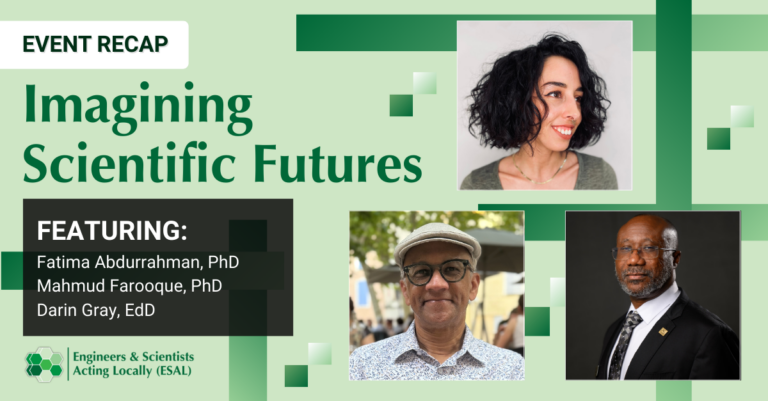
On October 2, 2025, ESAL hosted a virtual panel event titled “Imagining Scientific Futures: Opportunities & Hope in Difficult Times.” This event featured panelists:
Research Focus
The conversation began with reflections on how the focus of scientific research has shifted over time. Mahmoud Farooque, who is currently leading a community engagement project to gather public input on how we can shape the future of the NSF, reflected on the early days of the National Institutes of Health. He cited Vannevar Bush, a highly influential head of the Office of Science Research and Development (OSRD) in the post-World War II era, whose idea that research should be shaped by “free play of free intellects”, centering basic discovery without requiring accountability specific results or discoveries. “Historically, if you look at Science Policy in the U.S.,” Farooque said, “there's always been the tension between knowledge production and use. And it's a pendulum that keeps swinging from one direction to another, depending on the demand condition, technological opportunities, and our policy choices that we make.” He emphasized that this misses a crucial element by not centering the needs of the public and denying communities opportunities to give input on what research is done.
Fatima Abdurrahman reflected on what she sees in this moment as a way to learn from the past on how to incorporate communities into the scientific process. “We might take this as an opportunity to start treating the public less like the audience of science, and treating them more like the reason for, or even the co-creators of science. And by that, I mean grounding science in what the needs of people are. WhenI think about the enduring knowledge produced by Indigenous societies, it's all very need-driven. It's developing knowledge of ecology for land management, or of meteorology for navigation.”
Research funding
Funding cuts and uncertainty are weighing heavily on the science community. As federal dollars become more scarce and unpredictable, funding a community-centric future for science will require creativity. The panelists discussed crowdfunding as an option that provides funding for a project or researcher based on how members of the general public respond to their ideas. Fatima discussed her experience as an "independent academic,” receiving funding from members of her Patreon. “Something I absolutely love about Patreon is how good it is for back and forth,” she described, “I actually get so much feedback and engagement from the people who support me.” She uses the funds and feedback to produce research presented in her video essays available on YouTube. (Her latest video discusses the ideology of technocracy.)
Another emerging theme was the importance of building relationships between communities and scientists to create other avenues for financial support of science. Darin Gray described an example that he has seen: “When FIRST robotics came out years and years ago, it was really, really expensive to get a robot team started. All the big corporations were sponsoring some of the teams. And then what we found in our communities is that the local mechanic would be able to sponsor a robot team. There are a lot of people who would engage in things that impact their community.”
While hopeful about these creative ideas, the panelists still acknowledge that these methods would not be able fund complex projects independently and that state governments can and should play a role in stepping up to fill the gaps left by federal funding cuts.
Science and society
Throughout the discussion, the panelists focused on the importance of breaking down the false divide between scientists and community members. Mahmud addressed what might be standing in the way of building trust as a district of institutions. “Trust in science has always been kind of strong,” he said. “When we are doing our community dialogues about nuclear waste management, the question was, who do you want to see have oversight of this process? The proposal was that it should not be the Department of Energy, but an independent federal agency. But people actually like, not the idea of an independent federal agency, but of independent scientists.”
Darin emphasized through his experience as a science educator and outreach coordinator that scientific curiosity can connect communities together and the process of science can give them the tools they need to advocate for their needs. If people in the field can help reframe science not as something restricted to people with professional degrees and laboratory access, but as a process that can happen within our communities with community members as collaborators, we can build a more integrated future for science (See our coverage of a community laboratory, Counter Culture Labs, as one example of community-integrated science could look like).
Summary
The scientific community is facing the threat of much loss in these times. With all this uncertainty and instability, there are unique opportunities to make changes to create a research environment that addresses existing problems and better meets the needs of communities. This work requires continuous conversations and building networks that can enact change at many scales.
ESAL is working to build connections between civically minded people in STEM to strengthen our power to take collective action and help our communities thrive. We do this on our online platform, ESAL Community, which is free to join. If you would like to work with us to explore the relationship between science and society further, consider joining our community to work with us on a local action project.
Watch the full event recording on ESAL's YouTube channel.