Creating an Engagement Hub for Scientists And Community Members Anchored in a Denver Science Museum

ESAL had the opportunity to connect with Kristan Uhlenbrock, Executive Director of the Institute for Science & Policy of the Denver Museum of Nature and Science in the fall of 2024, and then again at the Colorado Convening hosted by ESAL and the kick-off event for the Trust in Science series in July 2025. 

This interview has been edited for clarity and length and includes updates provided after the initial interview.

ESAL: Tell us about the Institute for Science & Policy (ISP) at the Denver Museum of Nature and Science. 

Kristan Uhlenbrock: 

The idea for the Institute first originated in 2016, when the Denver Museum of Nature and Science was looking for ways to respond to growing politicization of science. The museum is a longstanding, science-based museum that is highly trusted and apolitical, and the mission of the Institute is to bring people together to work through hard problems while centering science in the conversation. I think of ISP as a combination of the work of nonprofit engagement and that of a think tank: we do community engagement work and produce helpful and technically specific products for policymakers to use. We are apolitical, but engage in political conversations. Our work is centered around people and the need to understand both the scientific information and how people receive and engage with that information. We try to break down the intense rhetoric around certain topics to get to conversations about the problems we are trying to solve. 

ESAL: What is an example of the type of projects you coordinate at the ISP?

KU:  The ISP hosts convenings where we get together a group of 15 to 20 people to discuss a science policy issue. One convening we hosted was focused on water, which, living in the West, is an extremely important and dwindling vital resource. There’s this saying, “whiskey is for drinking and water is for fighting,” and that is very relevant here in Colorado. For this convening, we gathered about 20 stakeholders together. We had three different scientists focused on climate change, atmospheric science, and water science, as well as water managers, farmers, producers, lawyers, policy wonks, advocates, and Indigenous representation. That group met over four months for full days at a time to build relationships and understand where each other's perspectives were coming from to create a vision of what they thought our water challenges were going to be and the pathways to get there in the future. 

Having scientists and technical experts at the table was extremely valuable, not only to them but to the process. They learned how their information can be presented in a way that is really useful to folks who need to make decisions or need that information in their community. Everyone involved gets to learn about how to interact when there is a diversity of stakeholders and interests. Because of the different perspectives involved, these gatherings allow for fascinating conversations that are illuminating on all sides. Ultimatey, this group created a report called The Roadmap to Better Decisions, which is really a process-focused report that they can use in their own lives and that others can use to set up a process like this. 

ESAL: How do you connect with scientists as part of this work?

KU: I come from the sciences, and through my career have built up relationships with many people invested in the questions we take on at the Institution. I view myself as the translator between communities.  Prior to this role, I was with a national laboratory, University Corporation for Atmospheric Research/National Center for Atmospheric Research (NCAR/ UCAR), where I worked on an interagency climate program for about five years. So, I have a depth of knowledge and relationships in the climate and atmospheric sciences, and I know a ton of people in that space. I then can use those strong relationships as connectors to other people in a larger network. I have also built relationships with our university partners and colleges, so I know who to go to when I am looking for people and ask them who would be a good fit for our projects. I then interview candidates to understand their interests, challenges, and skills that they bring to the table. 
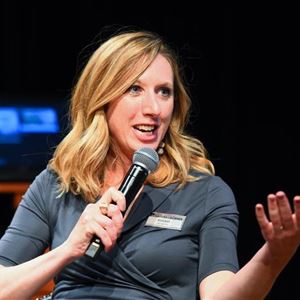
Image of Kristan Uhlenbrock speaking in panel
Kristan Uhlenbrock

ESAL: What initiatives are on the horizon for the ISP?

KU: We are building out fellowship opportunities, where scientists will be fellows at the Institute working on the issues we engage with. I am also working to launch a fellowship opportunity this year to place fellows in our state legislature, the Colorado Science & Technology Policy Program. We are creating a model that works for Colorado and learning from other examples, such as the AAAS fellowship in D.C. and California Council on Science and Technology (CCST), which have the most robust programs embedding scientists and technical experts in government. We have an amazing network and coalition of states that are focused on creating these science and technology policy fellowships to serve state houses, and we support each other as we navigate the diversity of how each state governs. As of this fall, we have selected our first cohort of four fellows for 2025-2026 and are excited for them to have the opportunity to serve the Colorado statehouse. 

We are also hosting a public event series called Trust in Science. The kick-off event in July was on the Science of Trust, and our next event in September will be on trust and vaccines. These events are hosted at the Museum, with some being streamed. You can watch the recording of the Science of Trust event here. (Kristan briefly discussed the latest at the ISP with us, view the video on ESAL social media.)

ESAL: What issues do you think are important for STEM professionals to engage around?

Misinformation and disinformation are critical issues right now. We are seeing a change in how scientists and institutions are trusted, with a decline overall but sometimes based on political affiliation or education. However, overall, scientists are highly trusted, generally at a higher rate than politicians or other institutions. Scientists are starting from a strong place as trusted messengers, and they have a responsibility to explain scientific information in an accessible way. We know that people have higher trust in the places where they live, and scientists are members of those communities–they are not separate. If you get outside your inner circle, you can help with bigger challenges. People will trust you because they know you. Tackling information can be at a large scale and at the local level. 

ESAL: What advice do you have for scientists looking to engage in science policy work?

This work takes stamina. Change is slow. You need to think long-term. Keep your scientific curiosity when approaching policy and engagement. There are windows of opportunity, and you need to be prepared to use them. You have to connect with people you disagree with and find common values and interests to work on the hard problems together. Stick with it, and take a long game approach. 

ESAL: How can scientists connect with you and the ISP?

I try to keep an open door policy, even though sometimes my responsibilities prevent that from always being the case. You can connect with me on LinkedIn and follow the ISP mailing list. We have small group meetings of scientists with the Institute leadership a few times a year, and you can get in touch if you are interested in being involved. 

Launch of Organizational Memberships with Fellowship Program for ESAL Community

Organizational Memberships to ESAL Community

ESAL is launching organizational memberships for ESAL Community. We heard your feedback and are responding to provide new ways to coordinate with organizations that share our goal to inform and inspire people with backgrounds in STEM to engage in their local communities. This opportunity provides a pathway to strengthen relationships between organizations and across our networks.

New tiers of paid memberships give organizations access to exclusive benefits, such as visibility within ESAL Community and on the ESAL website, space on the platform to support members working at state and local levels, training opportunities through a customized workshop for their members, and a fellowship program for leadership development. 

The Plans

You can find a full benefit list of the Organization Memberships to ESAL Community on the network landing page. If you do not see a membership type that fits your group's needs, reach out to us at info@esal.us.

ESAL Community Fellowships

ESAL Community Fellowships are designed to empower individuals from our partner organizations to lead meaningful local civic engagement projects that connect science, engineering, and public life. Fellows receive guidance, resources, and access to a network of like-minded STEM professionals who are driving change in their communities. ESAL will provide support for fellows with check-in calls, planning tools, and eligibility for local event support funds and sponsorship for community grant applications. 

This program is offered exclusively as a benefit of the "Builder" and "Mobilizer" organizational membership tiers within the ESAL Community.

How It Works

Partner organizations joining ESAL Community at the Builder and Mobilizer tiers receive up to 3 fellowship positions each year. Fellows are required to design and implement a local civic engagement project. The ESAL team will work with Fellows throughout the year to support their projects. Fellowship positions can be extended or offered to new candidates annually when the organization renews its membership. 

What Fellows Receive

Each ESAL Fellow gains access to:

Fellows may also be featured in spotlight posts or events highlighting their work and impact within ESAL Community.

Examples of Fellowship Projects

Fellowships can support new or existing initiatives that promote civic engagement at the local level, such as:

View our original articles for other examples of the type of initiatives ESAL would support.

Fellow Selection

Organizations are responsible for recruiting candidates for their fellowship positions. ESAL can provide outreach materials. Fellowship candidates must submit a brief proposal of a local civic engagement project or initiative they wish to start or expand. ESAL will work with organizations to select the ESAL Community Fellows.

Approved fellows will be given access to paid-member benefits in ESAL Community and invited to join monthly check-in meetings to support the growth of their projects. If Fellows wish to access financial support for their projects, either in the form of one time funds from ESAL to support an event or assistance applying for a community grant, they must complete a required request form. 

Please note that ESAL cannot financially support partisan initiatives, such as political campaigns or advocating for specific policies or ballot initiatives.

Successful Outcomes

A successful fellowship experience would include:

Whether launching new efforts, expanding current projects, or connecting communities around STEM and public service, Fellows will get the support they need to make a difference in their local communities.

Join ESAL Community as an organizational member today!

Do you have questions or want to discuss options? Reach out to us at info@esal.us.

Colorado Convening: An impact-focused gathering 

What happens when you bring people together in person to discuss the problems facing their community?

ESAL Executive Director Taylor Spicer and I (Al Licata, ESAL program manager) recently facilitated an in-person convening in Denver, Colorado, to learn the concerns and hopes that people in our network have for the state. On July 23, 2025, we met with 11 people with backgrounds ranging from textile recycling and science policy to corporate sustainability and public media, and brainstormed strategies to address local problems. 

How it came to be 

In reflecting on the current moment for people in Science, Technology, Engineering, and Mathematics (STEM), we planned this event to learn more about how ESAL can support people in our network in the Colorado area. STEM professionals are both facing a time of unprecedented instability in their fields, and have valuable skills to bring to the table in a time of democratic backsliding and the compounding crises that are likely to come along with it. We sought to bring together a group to explore what people are paying attention to in their local communities and the needs and opportunities for STEM professionals. 

We recruited participants from our networks to attend, asking them to share their backgrounds and concerns. Rocky Mountain Public Media helped us secure one of the conference rooms at Buell Media Center in downtown Denver to host the convening.

In bringing people together in person, we wanted to make connections between folks that share a geographic community. We started with an activity encouraging participants to find as many commonalities with the people they talked with as possible. Once we started to get to know each other, we shifted gears to talk about a strategic framework for community engagement and action. Taylor introduced a framework building a campaign by establishing aims, strategy, tactics, a plan for execution, and evaluation. With these campaign elements in mind, we discussed problems and opportunities facing the city of Denver and the state of Colorado. The group chose three topics to discuss: fire mitigation in Jeffco County, tracking rates of homelessness in Denver, and opposition to proposed funding cuts to the National Oceanic and Atmospheric Administration (NOAA) impacting the local workforce. 

To practice collaborative problem-solving, three “action committees” were formed to develop campaign strategies and tactics for each issue. Midway through the activity, we simulated adding STEM professionals with specific skills to their action committees and asked the groups to consider how they might incorporate those new members into their strategies. Each group took a different approach, focusing on different aspects of the problems and opportunities in front of them. The group working on mitigation strategies for potential funding cuts to NOAA focused on a systemic approach, emphasizing the importance of coordination between systems. The fire mitigation group outlined a complement of strategies from risk analysis to resilience and infrastructure planning. The group working on homeless rate tracking in Denver zeroed in on the need for better data collection and coordination with those most impacted to better advocate for affordable housing solutions. Adding simulated team members had a mixed effect, in some cases adding capacity in others adding specific network connections, resulting in varied impacts to the groups’ strategies and tactics. 

What we learned

Meeting in person matters. This is the feedback ESAL has received in multiple settings, including this convening. When asked about what they hope to see from ESAL in the future, there was strong support for more in-person gatherings. Participants also wanted these meetings to be action-oriented, striving toward working on a project or toward a concrete goal. There was a call for a follow-up to the meeting we hosted and a desire for deeper connection with other participants. This aligns with what we had expected: relationship building is a core part of how we can come together for collective action. 

People affiliated with STEM want to take action. It was clear from how the group engaged and wanted follow-up actions that people affiliated with STEM, either through their work, professional networks, or areas of interest, are motivated to make a difference in their local communities. Everyone approached local issues with thoughtfulness, creativity, and compassion and each person’s unique perspective brought valuable insights to the table. In the difficult political moment we find ourselves in with democracy itself on the line, it was encouraging to see how bringing people into a room together can bring forth movement and inspire civic action. 

Moving forward

The ESAL team plans to support a second gathering of this group. We have the tools at our disposal to virtually support organization of participants through our existing connections and the use of our new online platform, ESAL Community. The local hubs on the platform are an ideal space to connect folks in a single online location to share resources, ask questions, and organize events. Given the positive reception of the convening, we hope to organize others in different communities in the United States with small groups of interested people. If this is something that you would like to see in your community, please reach out and let us know.

The owner of this website has made a commitment to accessibility and inclusion, please report any problems that you encounter using the contact form on this website. This site uses the WP ADA Compliance Check plugin to enhance accessibility. Skip to content